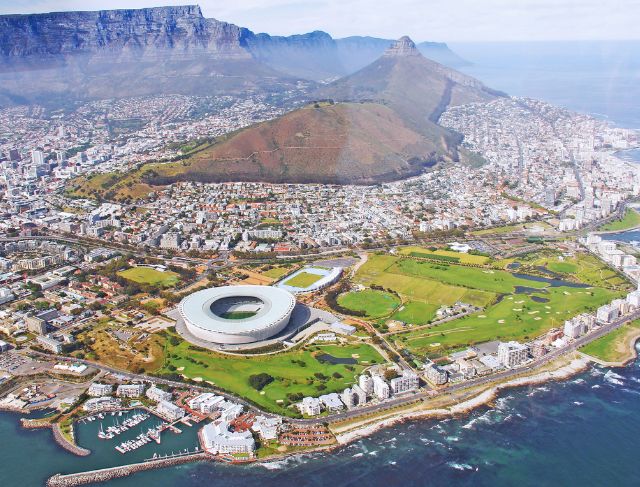

Understanding the historical context behind Cape Town is necessary to having a complete understanding of the city. Cape Town is often viewed as a stunning destination home to spectacular coastlines, internationally-renowned mountains, picturesque vineyards, and vibrant communities. However, the amazing landscapes we see today were built upon the foundation of exploration, colonization, warfare, racial segregation, and ultimately, the newfound hope of freedom and equality.
Every neighborhood, street and monument within Cape Town tells part of its history. Cape Town receives millions of tourists annually; however, most tourists only visit the scenic areas of Cape Town, but by digging a little deeper, you can see how culturally rich Cape Town really is and understand that many of the same socio-economic issues surrounding the lack of access to basic necessities still exist next to the beauty of Cape Town.
Before European navigators had even set foot in Turning Point (Cape Point), numerous humans had already occupied the Cape for approximately 30,000 years.
Some archaeological evidence found suggests that humans have inhabited the Cape for more than 12,000 years. Unfortunately, due to the lack of written records, we know little about how these early inhabitants lived their everyday lives. Most of what we know about the history of the early inhabitants is from archaeological evidence, rather than from written accounts.
By the late 1400s, everything changed for the region.
In 1488, Portuguese sailors travelled down the coastline of Africa and arrived at the southern-most point of the continent. This area had a harbour where local communities had established trade routes and was also believed to be the site of a major stop-off location for sailors on long-range voyages.
The first title given to this location was less than optimistic.
Due to the dangerous weather and storms regularly encountered by vessels in this region, the Portuguese named this area the Cape of Storms. Later on, this title evolved into the Cape of Good Hope which reflected the joy of being able to access the opening that connected the Atlantic and Indian oceans.
This name became known throughout the world.
As trade from Europe grew, Dutch colonies were formed at the Cape of Good Hope, which would be established as a permanent settlement.
This settlement quickly established itself as more than just a supply point for other vessels. As the area was developed into a colony, farms began to develop, vineyards were planted, and agricultural farming became the basis of this developing settlement. The introduction of grapes, wheat (although much of the wheat would come from the interior of the country), potatoes, and citrus promoted an agricultural economy that still continues in the Cape Wine Region today.
To develop this colony, Dutch settlers needed a source of labour.
From different areas in Asia, there were many enslaved workers for the burgeoning settlement. More settled immigrants came to this area directly from Europe. Using all the various cultures that had inter-mixed they influenced the local food, language, and design of homes, and how family traditions are formed.
Another European empire will eventually take over.
After Dutch occupation for more than a century as the Dutch had established over a period of many years their own political system, the British took the Cape and started using their own political system. As time went by, English has become more obvious in the area, and British government was using methods to reduce the Dutch influence in the area.
Many of the Dutch-speaking settlers did not agree to those changes.
They wanted to move further inland to create their own farming communities completely free from British rule. Those farmers are referred to as the Boers and their language evolved into Afrikaans, a combination of Dutch and local vernacular.
Afrikaans is one of South Africa’s official spoken languages today.
While the settlers expanded to southern Africa, relations between the whites and the indigenous Africans were becoming more and more unbalanced.
White and black people became segregated; that is the way of life was becoming separated. As gold and diamonds were found, the competition for land was getting tougher, resulting in conflict with the British, Boers and the powerful African tribes including the Zulus.
In the early 20th century, British Military had seized control of a considerable portion of the area.
The gradual shifting of South Africa towards self-rule, resulted in historically many political powers concentrated entirely among the white minority of South Africa. The white population, who comprised only a low percentage of South Africa’s complete number of inhabitants, controlled the majority of the nation’s central governed and all other made possible by the opportunity to be governed. The white community had very limited rights.
With the onset of apartheid, all of these inequalities between the races became worse and existed to an unparalleled level of severity.
Starting in the late 1940s, South Africa instituted the most rigid system of racially dividing its citizens ever taken by any nation’s government.
Each and every citizen of South Africa was to be categorized into one of the four major distinctively representative of the race group as designated by the government. All of the race classifications would have a definitive impact upon where one could make their residence, their choice of schools, their choice for employment, or ultimately their choice of a partner.
In addition, through government-created policies, the cities of South Africa were divided into distinctive neighborhoods based exclusively on the race of the individuals living within those communities instead of based on personal choice.
The impact of apartheid on Cape Town was extreme.
Cumulatively, hundreds of counts have lost the many generations of family representation by being forced from one home to another or more probable, forced from places where their families had lived for many, many generations. The millions of persons who were considered as non-white (Black South Africans) were removed from their previous residential areas and put into segregated housing (townships), which were located in areas beyond the reach of employment locations, which dramatically redefined the two (2) aspects of urban planning and ultimately the lives of all of the many millions of individuals who were affected.
The forced removals of Black South Africans and the manner in which these removals were carried out continues to occupy some of darkest chapters of the history of South Africa.
The resistance to apartheid did not die out.
Although severe government crackdowns occurred, political organizations continued to challenge apartheid in South Africa. Many anti-apartheid activists were imprisoned, forced into exile or silenced by anti-apartheid laws passed after the state of emergency was declared in South Africa. Nelson Mandela was one such anti-apartheid activist and became an internationally recognised symbol of the struggle against racial oppression after being in prison for 27 years.
As the decade progressed, the international community increased pressure on the South African government to end the apartheid system.
Due to increasing pressure from international protests, economic sanctions and political unrest inside and outside of South Africa, the apartheid system was beginning to crumble. Restrictions on anti-apartheid organisations were lifted, censorship of those organisations was eased and anti-apartheid political prisoners began to be released from prison.
On February 11, 1990, Nelson Mandela walked out of prison after nearly 30 years.
Four years later, South Africa held its first democratic election with all South Africans eligible to vote. Nelson Mandela was elected as South Africa’s first Black president and created a new political era.
Nelson Mandela’s presidency became a symbol worldwide for reconciliation rather than for revenge.
While apartheid had officially ended, rebuilding a country divided by more than 300 years of unjust laws would prove to be more difficult than creating a new government.
Present-day South Africa has a high level of economic disparity, continues to face issues related to housing and still has strong divisions within society. Although there has been significant progress, repairing decades of injustice takes a lot longer than changing the law.
Understanding the history of Cape Town will aid healing from decades of statement above.
Traveling to Cape Town will be even more enjoyable and fulfilling in that travelers will know not just the important landmarks, but also the stories of how those landmarks were created. The mountains of the city, its neighborhoods, museums and other landmarks tell a unique history about an interesting journey throughout one of the finest locations in Africa.
Cape Town is more than just a beautiful destination.
It is a place where one can understand how a combination of geography, culture, politics and human resilience shape history, and why informed travelers often go home with more than just photos.