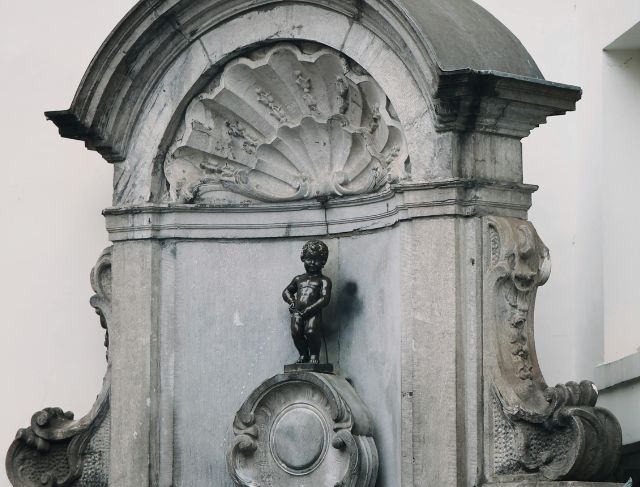

Many people will think of giant cathedrals, grand palaces, and massive monuments when they think of famous landmarks in Europe. However, Brussels takes a very different perspective. One of the most popular attractions in Brussels is the bronze statue of a little boy urinating, which is just above the height of a toddler. This little statue, known as “Manneken Pis,” has become one of the worlds most recognizable symbols of Belgium and millions of tourists travel from all corners of the globe each year to visit.
At first, many may find it difficult to understand how such a small statue could be known around the world. However, that’s what makes Manneken Pis so appealing; its whimsical nature represents a lot of what defines the culture of Brussels: through humor, resilience, and not taking life too seriously.
The Reason for Manneken Pis Fame
Unlike other statues throughout history, many of which are dedicated to kings and military victories or commemorate important political leaders, Manneken Pis is a representation of everyday people. For centuries, the Brussels residents have embraced this small statue as a reflection of the character of their city.
It has survived wars, vandalism, attempted thefts and historical events. Through all that time Manneken Pis has stayed an important symbol of the City of Brussels and has been ingrained into the identity of the City.
Visitors might arrive expecting a large monument and find it is much smaller than they thought, but after learning its history, they understand why the locals are so proud of it.
Manneken Pis has many interesting things about it. One of those things is that we do not know why it was made (the date, the age, the author).
Historical records have mentioned it only since the 15th century, when there was a water distribution system in Brussels. In those days, public fountains were very important for getting clean water for the people living there.
Although we know historically that the statue was made and existed, we still do not know about the reason it was made like this. The reason that it was designed that way has led to various stories.
One of the most popular stories is that a young boy saved Brussels from being destroyed. The enemy had planted bombs near the walls of Brussels. A young child found a lit fuse and extinguished it in a way that no one expected, thus saving thousands of lives and making him a hero to all the people.
Another account by the Mother of the Boy from the legend tells of a wealthy woman whose son got lost whilst she was shopping; this lady searched high and low and eventually found her son casually urinating on a corner of the street; they were so relieved and amused that they decided to create a statue of it to commemorate their son’s act.
Another version which is possibly more entertaining describes a young Duke placed into a basket on a battlefield and as the enemy troops advanced toward him, he reportedly urinated on them from above, which encouraged his army to fight harder and helped secure their victory.
The veracity of any of these stories remains unknown but they capture the playful spirit of the statue.
From Water Fountain to a City Symbol
Before current plumbing systems were invented, fountains were about providing useful services; Manneken Pis served as part of the Municipal Water Supply System in Brussels.
By the beginning of the 1600’s the statue was already becoming a well-known Landmark; it was shown in multiple artistic works indicating that people associated the statue with being a significant feature of their city.
After successive significant events (Wars and/or Foreign Occupations) that rendered Brussels severely damaged, Manneken Pis continued to be a feature of the city.
As time passed by, citizens started to see Manneken Pis as proof of their strength. The monument became more than just water, it became a symbol of identity.
Three hundred years of survival
Many landmarks are lost due to wars/political struggles after hundreds of years. But Manneken Pis has been able to survive all these events.
The statue has also been stolen on several occasions; on some occasions completely removed; on others, various parts of the statue have been vandalised.
Perhaps the most famous theft occurred in the 1960’s when the statue was stolen from its location, then later discovered floating in a canal. This event received extensive media coverage and increased the public regard for the little statue.
Presently, the original statue is safely on display at the Brussels City Museum; the statue that people see today outside of the museum is actually an exact replica of the original.
This has allowed for the preservation of a historical treasure for the future, and still provides people the opportunity to see the world-famous fountain where it has been for hundreds of years.
What makes this story of Manneken Pis so unique? The costumes he is often seen wearing are a large reason.
Many cultural organizations, groups and visiting delegations have generously donated thousands of costumes to the national collection of costumes that represent a variety of professional occupations, historical figures, sports teams, national cultures and special events.
The national Manneken Pis statue has a year-long schedule for dressing him in different outfits according to the time of year.
Some of the different costumes have been exquisite while others have been amusing, and still others have been downright strange.
Beer, Festivals, and Humour
Brussels has never been afraid to show off its little jewel.
During certain festivals, the fountain has been known to participate in public celebrations in unexpected ways. On special occasions, the fountain has been known to serve beer or other alcoholic beverages instead of just the usual water.
These traditions all emphasize an important part of the Belgian culture, which is a mix of humour with a passion for the community.
Instead of treating this monument as a religious landmark, the inhabitants of Belgium treat their statue as an entertainer. This has allowed this historic landmark to remain meaningful to future generations.
Manneken Pis is a very easy-to-find statue, located a few minutes’ walk away from the beautiful Grand Place in Brussels, Belgium—one of Europe’s most renowned public squares. Visitors will often wander around the streets that surround the fountain before heading to take a picture with the famous statue. The area is loaded with historic buildings, cafés, chocolate shops, and dining options.
As Manneken Pis is quite small, it helps to have realistic expectations upon arrival. What makes Manneken Pis interesting is not the size of the statue but the rich history associated with it.
Spending just a few minutes watching the statue while imagining all the stories, legends, and traditions associated with Manneken Pis over the past 400 years will make your visit much more memorable.
Why This Little Statue Is So Important
While some unique places, such as the Eiffel Tower and Big Ben, capture the attention of crowds because of their large size; however, there is one location that is not impressive due to its size or height but instead because of what it represents culturally. Manneken Pis (a little boy urinating in a bronze statue) is proof that a location does not need to be tall or large to be culturally significant.
It is the stories that people tell, the memories that they make, and the attachment that the community has for a place that makes a place important.
This little bronze statue has been in place for hundreds of years and has become one of the most well-known symbols in Europe (not bad for a statue that most individuals could carry with one hand).
And maybe that is why tourists continue to come to see it.