
Greenwich Village is one of New York City’s prettiest locales and with its interesting buildings, charming streets, exciting dining spots, and artistic ambiance isn’t hard to see why. However, beneath it all is another side of the neighborhood which is shrouded in a deep mystery filled with strange deaths, ghost houses, secret tunnels, and unbelievable scandals.
If you are a person with an eye on historical sites, you can take a dark history walk around Greenwich Village to spot a rather curious side of Manhattan.
- Washington Square Park: A Burial Place
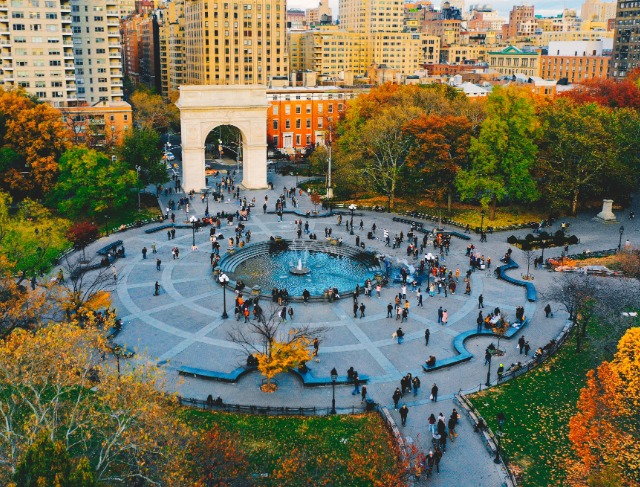
Washington Square Park is a favorite hangout among tourists, students, and street performers. It would interest you to know that the park used to be a potter’s field where approximately 20,000 people were buried.
Many of the people buried in this park were victims of the yellow fever epidemic that occurred in the 19th century. It is said that the old burial ground came to light during the construction of Washington Square Arch in 1892.
Washington Square Arch is a historical monument dedicated to the fact that George Washington was the first president of the USA in 1789.
- The Tree of Hangs situated at McDougall and Waverly Streets
A rather unremarkable tree that is situated at the junction of McDougall and Waverly Streets is known for its unpleasant background. The tree, which has the name The Tree of Hangs, is said to have been used to execute people in the 18th and 19th centuries.
Some locals claim to have seen figures hanging from the tree during thunderstorms.
- The Jefferson Market Library Building with a Remarkable Murder Verdict
Its fame particularly grew when the infamous 1906 murder case took place there. Stanford White, the architect of Washington Square Arch was murdered by actor Harry Thaw who was engaged to the actress Evelyn Nesbit after learning that she was having an affair with Stanford White.
Thaw defended himself by claiming insanity and was found not guilty.
- The 12 Gay Street Haunted Residence
This building is one of the eminent homes of American architecture as it is built in the Federal style and dates back to 1827. It is also related to the person named Jimmy Walker, who served as the mayor of New York.
When alcohol was prohibited in the U.S., this building hosted an underground bar called the Pirates Den. Walker used this illegal bar for personal purposes.
People say that he haunts the neighborhood with his music.
- The Stonewall Inn: A Place of Controversy
The Stonewall Inn has been recognized as a National Historic Landmark due to its contribution to the LGBTQ+ movement in the U.S.
However, before it became known as a symbol of the LGBTQ+ movement, it had a history of connections with crime. Until the late 1960s, it was known for its connections with mafia and money extortion.
The police raided the inn in June 1969, and patrons did not obey orders and protests against police began.
- The Hess Triangle: The Smallest Private Property in New York
Adjacent to the Stonewall Inn is a small triangular parcel of land known as the Hess Triangle.
Its fascinating history dates back to when the City of New York decided to adopt a grid street system at the onset of the 20th century. Property owner David Hess opposed his property’s acquisition by the city and, after a long court battle, managed to keep a small piece of land.
His family later sold to a neighboring business.
- 45 Grove St: An Underground Railroad Stop
Greenwich Village was part of the history of American slavery at this disgusting time in American history. The building located at 45 Grove St works with the Underground Railroad and was used as a safe stop for slaves who had won freedom and were headed to Canada.
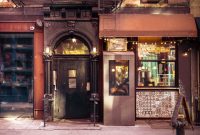
Chumley’s, located at 86 Bedford Street, was another popular speakeasy born during the prohibition era.
The bar had hidden exits and corridors to help customers escape from police raids. Legend has it that Chumley himself used these secret passages to help his customers avoid arrest.
Chumley’s has a certain history of tragedy related to violence and the death of the owner’s wife, and people say that the widow’s spirit still wanders about the building.
Cherry Lane Theatre: it was originally built in 1836 as a brewery and became an Off-Broadway Theatre in 1923.
The theatre also helped the careers of such performers as Barbra Streisand, and also serves to show how long Greenwich Village has been associated with the artistic community in New York City.
- Grove Court: From Poverty to Luxury Homes
The venue known as Grove Court is a breathtaking assembly of historical houses built in 1848.
But this place used to have a very different name. Pigs Alley and Mixed Ale Alley were associated with miserable living conditions and cramped housing for servants.
Today this quaint yard is recognized as one of the most distinctive residential areas of Greenwich Village.
- The Apartment Building from Friends
The building located at Bedford and Grove Streets can be recognized by the fans of the sitcom called Friends.
Although all of the scenes were shot in Los Angeles, the exterior of Monica and Rachel’s flat was shot in this building in Greenwich Village.
The diner located below is called The Little Owl, and it has an owl in its logo that can be found nearby.
An unusual construction in the area is 75½ Bedford Street.
The width of this very narrow house is approximately 8.5 feet. Its total area is around 990 square feet. The estimated selling price is $3.3 million.
This place has a literary importance as well because it has been home to poet Edna St. Vincent Millay from 1923 to 1924.
Explore Greenwich Village Beyond its Beautiful Buildings.
Greenwich Village is known for its interesting architecture but there is a lot more to discover in this area, including mass burial sites, haunted bars, and historic theatres.
While taking a walking tour in the area, tourists learn that New York has a number of interesting stories discussing crime history, social change, entertainment, and urban development.