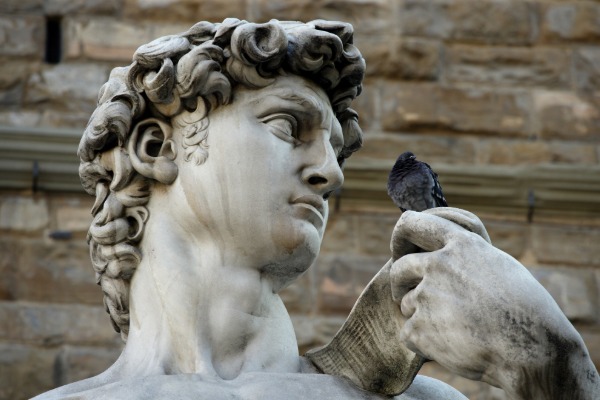

The experience of standing in front of Michelangelo’s David has been described by many as bizarre. You’ve seen it in photographs on the internet; you’ve probably also seen postcards or documentary films or bought a souvenir of it. However, photographs are not a good representation of how it feels to actually be standing in front of a sculpture which stands at over 17 feet tall.
When David was created, he was not intended to be the superstar of Florence. In fact, prior to being made into what would become one of the most famous pieces of sculpture in history, the enormous piece of marble that was to become David was seen as an issue that no one wanted to deal with.
Before tourists began coming to see David, Florence had already made plans for David to be one of the many sculptures used to decorate the new Duomo Church which was being constructed at the time. This church was going to have a number of large sculptures to represent the heroes of the Old Testament.
The initial problem with creating David began with the enormous piece of marble that was transported from Carrara (a region that is known for providing fine qualities of marble) and was around 12,000 pounds. This huge chunk of stone was far from perfect; many artists had previously attempted to work with it.
And they failed. A sculptor started to create the image, but when he was finished, the work had not even begun! The next artist attempted to finish the marble years later and also left without finishing what he had begun, leaving the marble exposed and untouched for many years until it became known as a failing art experiment.
Then a new artist came into the picture. At the tender age of 26, Michelangelo accepted a task that others had already turned down; that being, to create a statue from this spoiled block of marble. Everyone saw it as a worthless pile of damaged stone. To Michelangelo, however, it was a masterpiece waiting for him to bring to life.
So for three years, he invested himself in transforming this neglected block of marble into an extraordinary work of art.
And he did!
Michelangelo chose not to depict David as the victorious hero that most artists had rendered after slaying Goliath. Instead, he chose to depict a moment before David fights against Goliath; a moment of extraordinary concentration and determination on David’s part.
This choice ultimately changed the way that many future artists would portray the biblical story.
Whereas some earlier artists depicted David as a boy, Michelangelo chose to portray David as an adult, confident and waiting for his life-altering battle.
This decision also provided an element of anticipation unparalleled in previous pieces of art.
To this very day, many look to David’s face to see what he was thinking or how he felt at that moment. He has no smile; he has no victorious emotion; he either has not yet thought of the battle; or he is calculating his next move!
One of the most remarkable attributes of the statue is its realism. The detail given to the veins, the muscles, the way he’s positioned, and the features of his face are remarkable and also greatly detailed. At times it is almost hard to fathom that the sculpture was carved from only one block of stone.
Florence was quick to accept the sculpture as more than simply an artistic work of art-it became the symbol of Florence.
There were very many similarities in the city of Florence and that of “David”; the Republic of Florence saw similarities in their fight against larger political powers. Just as David defeated Goliath, so too has the city of Florence been small but managed to overcome dominating political forces everywhere.
This symbol has transformed the statue of David from being just a work of art to becoming a cultural icon.
Ironically, the statue of David never ended up where the planners planned for it to go. Originally, the statue was to be placed high on the Cathedral of Florence; however, after the statue was finished, officials realized the statue was just too magnificent to put in a place where it would not be recognized.
Instead, they decided to display it in the center of Florence, allowing residents and tourists to closely view the statue.
In recent years, because of damage caused by the weather, there has been yet another relocation of the statue; the original statue was moved indoors to the Galleria dell’Accademia where it is located today.
If you are traveling to Florence, the statue of David will be one of the objects you will want to visit.
Many people who visit the city find it shocking that they can see more than one version of the sculpture David throughout the city.
The original piece of art is located in the Accademia Gallery.
A replica made of marble is located in the same outdoor spot where the original was kept, in Piazza della Signoria.
A bronze version of David has a bird’s-eye view of the city at Piazzale Michelangelo. This is one of the best places to take pictures of Florence due to the outstanding panoramic view of the city from that location.
With the replica’s so diligently executed many tourists sometimes think they are looking at the original work when they are actually looking at the copy.
A lesser known detail about David is that his two eyeballs are not symmetrical to each other.
One eye appears to be slightly larger than the other.
Neither one of these things was an oversight.
Michelangelo made the design of the sculpture to be looked at from low or ground level. This minor adjustment to the position and angle of David’s head means that when it’s viewed from level with the body (as David would be were he alive) his gaze appears more like that typical of someone looking at another person standing at ground level.
This tells us a lot about how important the details of the statue were to Michelangelo.
More than five hundred years after the completion of the statue David still attracts millions of people to go visit him in person. Artists come to see David to learn about and study art. Historians come to study David to learn about history. Tourists will plan an entire itinerary for their trip to Florence around the statue of David.
Perhaps this is the most telling aspect of the story.
A block of marble that was laying alone outside for more than three decades became one of the most incredible pieces of art created by mankind.
Not too shabby for an artwork everyone else thought was too much work to finish.
If Florence has a face, David would be that face.