
Many American metropolitan areas are expanding toward the boundaries of their existing municipalities, while San Francisco has had to find alternative methods of city development such as moving upwardly through the use of existing buildings–sideways around hills–through subways and tunnels (to connect the city via subway) and using land from previous water bodies but still have a functional city as well.
These unique methods of developing the city contribute to the confusion most first-time visitors experience when visiting San Francisco due primarily to the drastic fluctuations in the level of the streets and buildings while traversing the respective street networks.
Despite the apparent chaos of San Francisco’s built environment, it is that very chaos which creates the lasting and memorable character of the city to multiple generations.
Understanding how to appreciate San Francisco’s famous landmarks such as the Golden Gate Bridge, cable cars, or unique neighbourhood will require an understanding of one important factor in the growth of San Francisco, namely, the infrastructure of the city has always created unique challenges to the urban planner.
San Francisco is located on a narrow peninsula that sits between two large bodies of water. Steep, uneven topography, unstable soil, and the threat of earthquakes contribute to the inherent difficulty of simply building a city on the same peninsula for the past 200 years.
Ironically, many of the most popular tourist attractions in San Francisco were created or exist due to the geographic challenges faced by the urban planner.
Visitors often regard them as charming places to visit. In fact, they are a byproduct of necessity. The height of San Francisco’s hills provided a great obstacle to reach the top of the hill with traditional forms of transport in the late 19th century.
At that time, a revolutionary form of transport came into existence.
Before this time, there were no means of going up and down the extremely steep hills of San Francisco. With the introduction of cable cars, people could go up and down the hills of San Francisco easily and without much effort, which opened a vast number of unexplored areas to potential development. Wealthy families quickly moved to the top of the hills, where they could have better views and cleaner air.
Nob Hill and other hilly areas throughout the Bay Area carry this legacy.
The hills are the defining characteristic of the city.
City maps do not show how hilly the cities of California actually are. From a map and a layout of streets, they are straight and orderly. By walking on the streets, you will determine that they are more like trails on a mountain than they are like blocks in a city.
The unique geography helps to define the unique character of San Francisco in comparison to most of the other major cities in America.
In addition to influencing how well developed neighborhoods were, the hills of San Francisco influenced the neighborhoods’ identities. For example, the name of each of the following neighborhoods represent a story related to the hill on which it is positioned: Russian Hill, Nob Hill, Potrero Hill, Rincon Hill, and Telegraph Hill. We generally refer to the neighborhoods by the name that signifies the hill that they are located on rather than using names that might signify a developer or some other kind of identifiable landmark.
Long before the neighborhoods referred to above existed, this area was home to the Indigenous people known as the Ohlone. Following them, the Spanish settlers arrived and built Mission Dolores in the late 1700’s and this is still standing today. Mission Dolores is still the oldest building in San Francisco.
From this area, the Mission District developed as a result of Mission Dolores and was one of San Francisco’s more vibrant neighborhoods.
And then, everything changed.
Gold was discovered in California.
What happened to San Francisco was a change from being a small, established settlement to a city with a substantial population due to all of the fortunes that were made by so many who came to California searching for riches.
While very few individuals actually became wealthy as a result of the gold mining, it was to the merchants and property owners and entrepreneurial individuals who sold goods and services to the miners that benefited in a significant way.
The growth of the population in San Francisco occurred at what most people today would think is an impossible rate. Therefore, as more and more people who come to San Francisco, the landscape of the city changed.
The harbor was filled with the ships of gold miners that had been abandoned, those that had sunk, and those that were simply left behind. Over time, areas of the waterfront were also filled in to make new land where water had once been.
You would be amazed at how many modern-day buildings can be found on land that was originally part of the bay.
Besides being created by people arriving from other places, the Gold Rush changed the demographics of San Francisco, making it one of the most ethnically diverse cities in the U.S.
One of the first groups in San Francisco was the Chinese immigrants, who built what would eventually become America’s first Chinatown. The Italian community also created a successful fishing industry on the waterfront.
Both groups made significant contributions that continue to shape San Francisco today.
If you visit Chinatown, the largest Chinese community outside of Asia, you will see just how well Chinese culture has thrived.
A walk along Fisherman’s Wharf will give you insight into Italians and their long-standing traditions in the city’s culinary arts and maritime business.
Disaster has also played an important part in San Francisco’s history.
In 1906, an earthquake devastated San Francisco.
While the earthquake had caused much of the destruction, the fires that followed caused even more damage. Neighborhood after neighborhood was consumed by flames for days as they marched across San Francisco.
Hundreds of thousands of residents lost their homes.
Reconstruction was an epic building project on a scale not previously undertaken in America’s urban experiences.
Many neighborhoods we recognise as visitors today were created during this recovery.
For example, the Richmond and Sunset Districts grew greatly as refugees looked for new homes away from their former neighbourhoods.
The avenues were named “The Avenues” for their easy to follow numbered street format.
Whereas navigating within San Francisco is often very confusing due to the haphazard layout of downtown streets, it is relatively easy to navigate The Avenues.
San Francisco may be less difficult to navigate than some other cities, while some other cities are very difficult.
Eventually, as San Francisco grew further than its natural extension, our engineers dug even farther through the hills and built massive bridges to connect the peninsula to the surrounding areas.
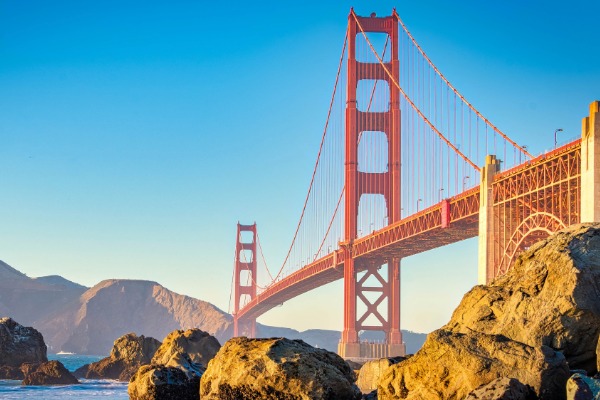
The most notable of those are the Bay Bridge and Golden Gate Bridge that connect San Francisco to Oakland and the rest of the Bay Area.
At the time of their opening, the Bay Bridge and Golden Gate Bridge were both monumental engineering accomplishments.
Today, the Golden Gate Bridge has become one of the most photographed objects of any kind on the planet.
With all of the bridges and tunnels built into and under the city, San Francisco never became a city dominated by freeways like the vast majority of other American cities.
Some freeway projects have been cancelled or construction has stopped on freeway projects, and therefore, large sections of the city are very pedestrian friendly.
Going on foot allows you to explore and discover many interesting things, including numerous ways of getting to places around the city via the historic district, waterfront parks, secret staircases, colorful Victorian homes and several panoramic views.
At times, the best routes you will take won’t be found on your GPS.
There are numerous examples, such as locals finding hidden staircases or pathways through neighborhoods up steep hills.
Many of these routes do exist and, if you are looking for them to help you understand how to view the city in a different way, they will provide you with that opportunity.
San Francisco was never created as a city designed for convenience.
It was built based on geography, reinvention, immigration, innovation and survival.
The hills have created difficulties for the city’s residents; however, those residents created character from those difficulties.
This is why San Francisco does not feel like it is perfectly organized or planned; instead, it feels like an ongoing experiment being created among the ocean, bay, and a collection of hills that have been here throughout time.
Ultimately, San Francisco is a more interesting city than it could have been if it had been planned out from the outset.