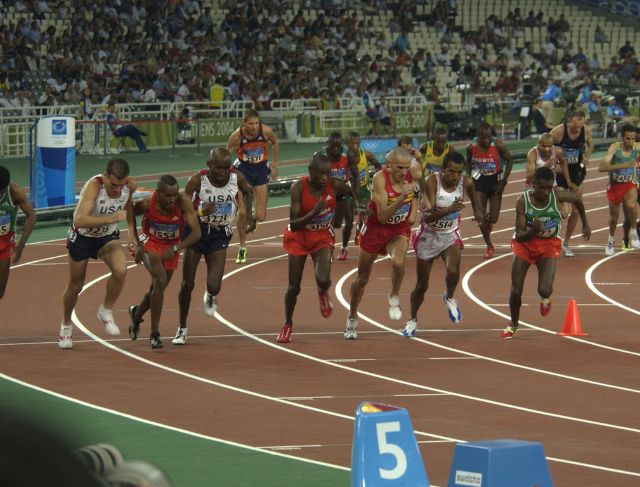

The concept of the Olympics may be something that we take for granted now, however, it very nearly didn’t even exist.
Most people associate the Olympic Games with world records, memorable triumphs and athletes hopeful of the medal that reflects their country’s greatest accomplishments, but in reality, the greatest achievement of the Olympics has little to do with medals; The greatest achievement of the Olympics is the fact that every four years countries with vastly different cultures, languages and political views come together in one place to celebrate their shared passion for athletics.
In the past, it would have been difficult to visualize what the Olympic Games would be like today, given how drastically different the original Olympic Games were from the modern Olympic Games.
The original Olympic Games occurred around 776 B.C. in Ancient Greece prior to the advent of television broadcasts, sponsorship deals, and huge opening ceremonies featuring fire works and all of the common features of the modern day Olympic Games. At that time, the actual athletic competition was conducted in an environment that was different from that of the modern Olympic Games; the athletes competed without the modern day uniforms, and the competition was a part of religious ceremonies held in honour of the Greek gods, as opposed to promoting the idea of international unity.
Although the Olympic Games created opportunities for Greek city-states immersed in wars and conflicts to put aside their differences by ceasing hostilities temporarily so that athletes and spectators could make the journey to the games safely, in 393 AD, the course of the Olympic Games changed.
With Christianity on the rise in the Roman Empire, Emperor Theodosius I banned many of the pagan traditions, such as the Olympic Games. The Olympic Games, which were once regarded as an ancient sporting event, ceased to exist.
After centuries of being relegated to history books only, the Olympic Games underwent a transformation when the end of the 19th century saw an individual by the name of Pierre de Coubertin (a French educator) develop the concept of creating competitive events (the Olympic Games) that would enhance participation in sports, foster the development of individuals through competition, and encourage peaceful relationships between nations. Although de Coubertin was dedicated to recreating the ancient festival through the Olympic Games, he created an event that would promote values of discipline, respect, friendship, and fair competition among athletes from countries around the world.
The foundation of the current Olympic movement came from his (Pierre de Coubertin) dream to unite all the nations of the world.
After Pierre de Coubertin expressed his dream in 1894 to establish the Olympic Games, the IOC was created and two years later the first modern Olympic Games were held in Athens, Greece. Holding the games in Greece was significant because it tied the new Olympic movement to its ancient heritage.
In 1912, the Olympic Rings were created. Each of the five interlocking circles represent an inhabited continent. The colours selected for the rings were purposely chosen to represent at least one of the five colours of each of the flags that existed at that time. Therefore, there was a symbolic message of inclusion for all nations—the message being, All Nations Belong.
The Olympic Games have gradually become more inclusive of all types of athletes since the Olympic Games began. Women began competing in the Olympic Games in the early part of the 20th century. Athletes from various ethnicities began participating in the Olympic Games in a time when many countries were having great difficulty ensuring equal treatment to all its citizens. And today, when the Paralympics has been created to provide an opportunity for athletes with disabilities to compete at the highest level possible, and the Refugee Olympic Team represents a way for displaced athletes to compete at the international level, it has demonstrated the Olympic Movement’s commitment to inclusiveness.
Politics and the Olympic Games have always been connected.
Using the Olympic Games as a way to show the world what kind of nation a country is has been common for hosts of the Games for all of Olympic history.
For example, the Berlin Olympic Games in 1936 were intended to present a projection of Nazi Germany to the World, but after winning four gold medals, Jesse Owens turned that particular projection of Germany upside down, and became one of the greatest all-time Olympians in history!
When Japan hosted the Olympic Games in 1964, it was more than just a sports competition. The Olympic Games were symbolic of Japan’s tremendous rebirth since World War II, and represented Japan’s emergence as a peaceful, modern and ready nation to join the international community.
The Olympic arena has also provided many opportunities for athletes to get their point across without saying much.
As an example, Tommy Smith and John Carlos raised their black-gloved fists on the medal podium at the 1968 Olympic Games in Mexico City as a form of protest against racial injustice. This silent act of defiance became one of the most recognised moments in world sporting history, and illustrates how one particular sporting event can often represent the greatest conversations in society today.
Even sports in the hockey world were afflicted by cold war difficulties.
In 1980, United States Men’s Hockey Team beat the Soviet Union who was anticipated to win, to this day remains known as Miracle On Ice. This was more than just an upset, but a historic moment during one of the most politically divided timeframes in world history.
Years later, during another Olympics, another significant emotional moment occurred.
Following the events of September 11th, The Olympics of 2002 in Salt Lake City, represented resilience and hope to millions of people throughout the world who would come together at the same time to participate in a sporting event regardless of such a recent tragedy to have occurred.
One other interesting part of Olympic history is discussed in connection to professionalism.
For most of the 1900’s it was believed that all Olympic athletes would participate in the games as amateurs. Any type of professional sport activity would prevent an athlete from competing in Olympic competition. Athletes such as Jim Thorpe had his Olympic medals taken away from him due to his professional baseball history even though many other olympic athletes have participated in professional sporting events prior to being in the olympics.
As all the restrictions were lifted, the athletes you see appear in all Olympic Games now are the absolute best at what they do, and they have the highest level of competition there.
Olympics continue to be hosted in cities all around the world, creating enormous stadiums that will last forever, inspiring remarkable memories, and providing endless stories that last well beyond the closing ceremony. Each new host city writes a new chapter in an ongoing two-thousand-year-old story.
Today, the Olympics do not just measure which athlete can run the fastest or compete the strongest, but they also provide insight into humanity itself.
Each Olympic Games provides a snapshot of that point in time, the triumphs of our world, the wars of our planet, the hopes for our planet, and our determination to move on. Therefore, Olympic history is much more than a calendar of medals evolved through time; it is one of the most captivating stories in history told through sports.