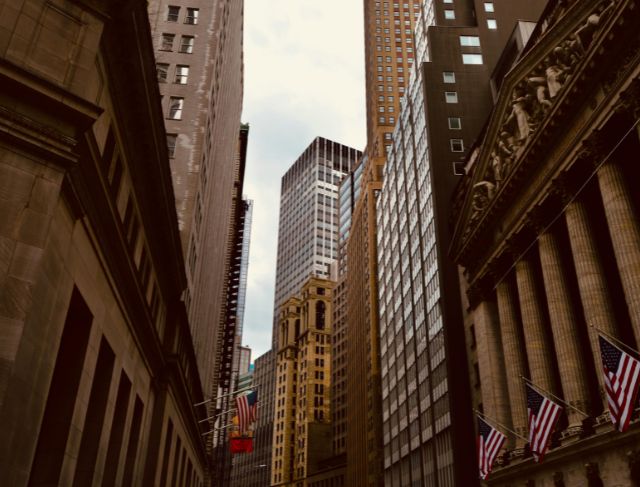

Today, being on the corner of Wall Street is like being surrounded by solid modern energy, with glass towers, crowds rushing past each other, and the constant hum of global finance surrounding you. The former is only part of what makes this an infinitely interesting place; it is about everything that has happened here long before any skyscrapers were ever built.
Going back far enough, this area was not the city you see now; it was a forest inhabited by the Lenape people who lived there for generations. Then, in the early 1600s, the Dutch came and turned this portion of Manhattan (the southern tip) into a small colony called New Amsterdam. At that time, there was no ‘city’ but a compact group of homes located at the edge of the island known as a colony.
The first major construction project the Dutch implemented was to build a wall for defence around their colony from outside threats. The wall ran along the northern border of their colony, protecting against perceived threats. The wall was lost over the years, but the name for the wall dated back to the beginning of the city and still exists today—you may find some markers on the street telling you exactly where it once existed if you are in the city today.
The really fascinating part is that much of the area did not contain land over time, due to the expertise of the Dutch in the manipulation of coastlines – they filled in portions of the bodies of water and created new areas of land. The streets today of Pearl Street used to be adjacent to the water, and now they are inland. The city literally expanded by building on top of the water.
Shortly after this, the British took control without any major warfare. They changed the name of the colony to New York and took down the wall and filled in the canals and put a new layout into place. One of those former canals became Broad St. which runs through the financial district to this day.
Fraunces Tavern is an example of how taverns became more than just somewhere to hang out, they became a place to have quiet meetings about revolutionary ideas. What started as quiet meetings turned into a much larger scale fight for independence from Britain. After the war, Washington held his final assembly with his troops at this tavern and by doing so, he marked the end of one era and beginning of another.
Just a short walk from Fraunces Tavern you will find New York City’s oldest park, Bowling Green Park. Today, it looks very peaceful. However, at the time of the declaration of independence, a statue of King George III stood in the park. The statue was torn down when the Declaration of Independence was brought to New York City. The metal from the statue was melted down to create munitions for soldiers. There are even indentations on the fence around the park where British emblems were removed hundreds of years ago.
For a short period during America’s transition from a colony to an independent nation, this section of Manhattan was the focal point of a newly formed country. Federal Hall which is located at the bottom of Wall Street served as the first capital of the United States and is the location where George Washington took the oath of office as the first president of the United States. There is now a statue that stands near where that historic event took place.
Political transformation has not been the only change occurring in the area; dramatic fires have had their share of shaping how things are today. In 1776, a catastrophic fire consumed large sections of New York City, which included many of the first buildings, such as Trinity Church. After several fires, new regulations were implemented prohibiting wooden building construction which encouraged builders to construct buildings out of stronger materials than wood (like stone) and eventually steel.
This change combined with improvements to engineering resulted in major changes, such as the invention of the skyscraper. The bedrock underneath Manhattan’s soil allowed for these enormous aboveground structures to be built. The explosion of new immigrants along with the growing population resulted in extreme density of people and lots of activity at the southern end of Manhattan and provided an excellent location for businesses to operate. Over time, that area of Manhattan became the financial centre of the United States.
Furthermore, Wall Street has come to symbolise the power of wealth. The New York Stock Exchange has become the symbolic centre of finance, with banks and other financial institutions clustered nearby. As a result of this rapid growth of Wall Street and its importance as the preeminent financial centre, when people refer to ‘Wall Street’, they do not just refer to an actual physical street, they are referring to the entirety of the financial system as it exists today.
The Charging Bull is another symbol that you see throughout this area. The bull was placed there in 1989 overnight by an artist. The bull was initially removed by authorities; however, after public outcry, the bull was put in a more permanent location nearby to symbolize strength and optimism in the market.
In addition to the Charging Bull, the World Trade Center (WTC) has a presence in the financial district. The WTC Twin Towers previously created a distinct part of the Manhattan skyline before 9/11, but now, the WTC has One World Trade Center (the tallest building in the United States) and two memorial pools to remember those who died.
While walking around the Financial District today, one could very easily consider the present day with buildings, businesses and lots of movement. Underneath all of that is the historical past, with layers upon layers, from Native American land to colonialism, from revolution to global finance, this tiny part of Manhattan continues to reinvent itself.
Ultimately, this is what makes it unique from other destinations; it is not only a place that money flows, but it is also the site of hundreds of years of transformational history still lying beneath one’s feet.