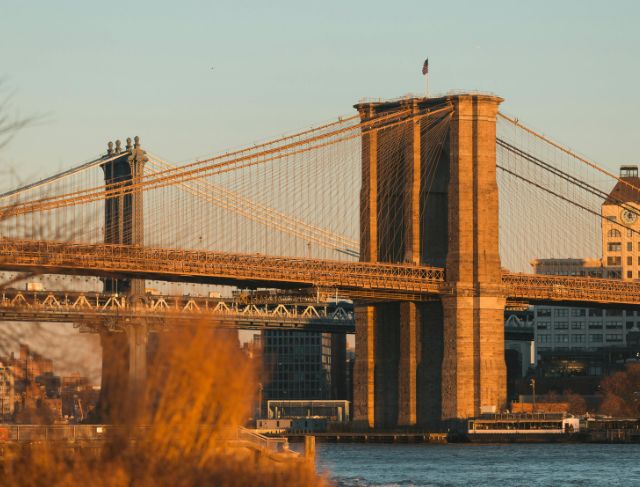

When it was built, the Brooklyn Bridge became the most photographed building on the East Coast, but that same bridge was also built to help connect Brooklyn and Manhattan over the East River, a long way from bus and train travel.
In fact, before the advent of automobiles and subways, even crossing the East River from Brooklyn-to-Manhattan was difficult-in fact, ferries were the only way to make the trip, and during frigid winter months, the ferry service would fail, due to total freezing of the East River. Although building a bridge to connect Brooklyn to Manhattan was an audacious idea at the time, insatiable public demand for a permanent link-offered the project principal with the impetus to move ahead with the project, despite the fact that no one had ever built such a large span.
John Roebling, an engineer who was pushing the boundaries with a crazy new idea of building the largest suspension bridge in history (by using steel wire cables instead of traditional chains), was slated to be in charge of a major new engineering project: The Brooklyn Bridge.
Unfortunately before John Roebling could build anything on this project he suffered a fatal injury that left the project in turmoil. At that point his son Washington Roebling took over the project and proceeded with construction.
In order to build the bridge it required workers to dig down into the riverbanks using extremely large and extremely dangerous chambers (Caisons) and then slowly push them further down into the water.
The workers began to get sick and even some began dying but nobody could figure out why until much later when it was given a name, ‘Decompression sickness’, but back then it was completely unheard of. Approximately 20 workers died and Washington Roebling himself became a victim of the sickness; however he did not die from it, but had become paralyzed and could not physically supervise the construction any longer.
At this point in the process, there was little doubt that all hope was lost for this project. However, there was an unexpected outcome when Emily Roebling (Washington’s wife) became involved with the bridge project as an unofficial engineer (she was never trained as one) and took over most responsibilities (relaying instructions, managing decisions) over time (becoming the on-site leader of the bridge).
Under her direction, the towers were completed, the cables were stretched across the river, and the bridge began to take its form. The years continued to pass and with them more and more setbacks would happen, but eventually it became apparent that this project would become a reality (the impossible was becoming possible).
On May 24, 1883, when the Brooklyn Bridge opened to the public, it signified not only new infrastructure, but a very significant moment in cultural history. There were celebrations with fireworks, massive crowds on either side of the bridge, and it became part of history. Emily Roebling was the first person to officially walk across the bridge, symbolizing her significant contributions to the success of the Brooklyn Bridge.
Not Everyone Believes In The Bridge Once It Opened
Despite being an engineering marvel, there were still a lot of people who did not believe in the bridge. Within just a few days after opening, a panic occurred on the bridge when one person tripped, causing a chain reaction of people to believe the bridge was going to collapse, and create a stampede, resulting in the deaths of twelve people. News of the stampede spread quickly, and suddenly the bridge became not as safe.
How Do You Convince A City That The Bridge Will Not Collapse?
You bring in elephants!
That’s right! Circus Owner P.T. Barnum brought a herd of elephants across the bridge to illustrate that the bridge could support large loads. Public confidence began to build in the bridge and over time it became a crucial part of everyday life in New York.
Since then, the bridge usage skyrocketed from one that was originally thought of as an experiment to later one of the main corridors connecting two of Americas’ largest cities. Brooklyn and Manhattan no longer felt like separate cities but rather one city connected by the bridge.
Walking over the Brooklyn Bridge today provides less fear than an experience. There are outstanding views of the entire skyline, an intriguing combination of historic and modern architecture, and a sense of being a part of something that previously seemed impossible. There are many layers of history underneath, such as hidden chambers, previous construction techniques, and the lives of those that were involved with construction.
To put it bluntly, the Brooklyn Bridge is more than just a bridge; it’s much more than just a way to cross from one side to the other; it represents all the things that were required to complete that simple journey.