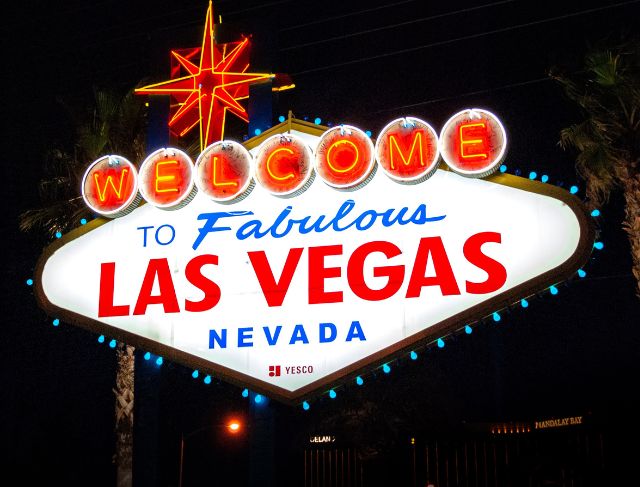

Las Vegas is thought of mostly in the minds of many people as only a city with huge bright lights, luxurious hotels, celebrity performances, and a variety of things to do. However, a surprising fact about the city’s history is that many visitors spend a whole weekend on the Las Vegas Strip, a famous and luxurious stretch of roadway – and have never actually visited the City of Las Vegas!
This unique situation is a perfect metaphor for a city that has been breaking the rules, adjusting to what is expected of it, and reinventing itself for more than a hundred years.
Before the mega-resorts made up the skyline, the area was just a diverse desert oasis. Local Native American peoples had lived in this area for hundreds of years using the natural spring waters to provide food in various forms.
John C. Frémont passed through the area in the 1840s while exploring the western frontier; he called the area Las Vegas which translates to The Meadows. No one at that time could have ever guessed that this little desert stop would become one of the most well known tourist destinations in the world.
Interestingly, the historical founding of Las Vegas has its roots directly tied to a group of Mormon missionaries who established a desert oasis there.
Brigham Young sent missionaries to establish a settlement in the area in the 1840s. They constructed a fort and attempted to develop the land, but the project failed after only a few years and was abandoned.
Although the original mission didn’t last, Mormon influence on Las Vegas has lasted for generations in ways that few realize today.
Several years later, a woman named Helen Stewart agreed that there were many future transportation opportunities possible in the area. She purchased property around the oasis in hopes that someday it would be useful. This decision turned out to be a very good . Some of the early railroad developers were looking to build strategic transportation hubs between Los Angeles and Salt Lake City.
Clark wanted more than just a few houses in the desert near the rail line; he saw the possibility of a much larger city.
The developing railroad increased the number of workers, merchants, travelers, and entrepreneurs that were attracted to this area.
The history behind this drastic change can be traced to several decisions made throughout a brief timeframe that altered everything.
To start with, local laws permitted many activities during the early 1900s in Las Vegas that were restricted by cities elsewhere, such as liquor and . This flexibility became a major factor for entrepreneurs as they entered into business in Las Vegas.
Secondly, enforcing Prohibition laws (which were enacted in 1920) against alcohol sales in a remote desert town was not very easy to do—therefore, the reputation of Las Vegas grew as a town that was willing to bend its own regulations to allow for open) illegal) conduct, including drinking alcohol.
However, it wasn’t until one of the largest construction projects in American history, the building of Hoover Dam, took place that Las Vegas experienced its largest growth in population.
During the Great Depression, thousands of workers were brought into southern Nevada to work on the construction of Hoover Dam. This created an extreme amount of demand for housing for those workers, as well as for customers for all types of businesses to serve those workers, and finally an extreme amount of demand for things to do in Las Vegas to entertain those workers.
Lastly, at approximately the same time that these decisions were made, the state of Nevada legalized. State leaders hoped that the revenues from s would benefit the state through taxes and economic growth.
They were absolutely correct.
Over time, the few initial eventually grew to become a multi-billion dollar industry.
With the easing of marriage laws in Nevada making it possible to get married more quickly and easily than in virtually any other state, state officials recognized an additional tourism boon as an opportunity for people to come to Nevada for or marriage – or to do both over one weekend.
With increasing visitation numbers, the next group to realize the potential of Las Vegas was organized crime. Organized crime partners were responsible for providing some of the financing to develop the early Las Vegas resort, which, due to the level of luxury and glamour that had never before existed in the desert, attracted many prominent artists, entertainers, and wealthy individuals to the city from all sections of the country, with the Flamingo standing out as the most notable example.
The Flamingo was the first integrated resort to combine luxury hotel accommodations, entertainment, and fine dining all under one roof, thus providing the formula for the modern-day Las Vegas resort.
Consequently, larger and more extravagant integrated resorts soon began to open in the city, which dramatically changed the way people viewed Las Vegas from a dusty rail town to the ultimate playground of America.
By the 1960s and 1970s, Las Vegas had become the epitome of excess, excitement, and continuous entertainment with legendary entertainers filling the showrooms virtually every night and providing productions unlike any other offered anywhere in the world.
Spectacle became the defining characteristic of Las Vegas City.
While discussions regarding the history of Las Vegas have traditionally focused heavily on mob influences, there is another surprising force that helped to redefine the city.
The businessman Howard Hughes was buying up large properties and investing in the area while businesses associated with Mormons were getting involved in a variety of business operations.
Together, the changing ownership structures led to a reduction in organized crime’s control over the businesses.
The city continued to develop.
Major themed resorts were built on a continual basis. Visitors could visit replicas of past civilizations, famous landmarks around the world and fantasy lands without leaving the state of Nevada.
The scale became larger.
The lights became brighter.
The competition became stronger.
By the end of the 20th century, millions of tourists were visiting every year.
But perhaps the most surprising aspect of this story is still being played out every day; many of the major attractions associated with Las Vegas — large s and portions of the strip — are all located in an unincorporated area called Paradise.
This relationship has given financial and regulatory advantages to help with development for years.
Many visitors don’t see it.
But honestly, it’s so Las Vegas.
The illusion of Las Vegas has thrived over time.
Currently, Las Vegas continues to transform itself.
There are new sports teams in town.
New large scale venues have recently opened.
The digital age replaces neon signs with powerful display advertising.
Las Vegas continues to recreate itself but retains enough history to be able to continue its mythology.
What makes Las Vegas unique is not just its , but its luxurious resorts as well. The very existence of Las Vegas can be attributed to those who viewed an empty desert, throughout generations have thought to created something great.
Some came for opportunities, while some came for wealth, while some came for second chances.
In a way, that same spirit defines Las Vegas today.
Within every illuminated sign or large sits a story of ambition, risk, or change.
Possibly the largest made in Las Vegas, is convincing the world that you can achieve the impossible within the desert.