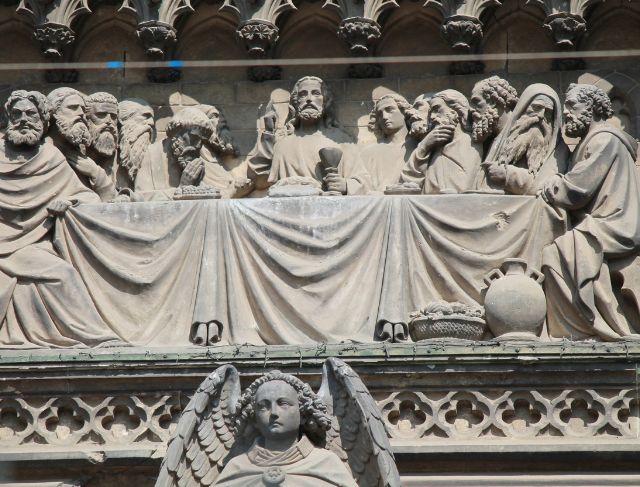

Most people think that a well-known piece of art becomes a timeless piece the instant it’s created. The Last Supper by Leonardo da Vinci started to deteriorate almost immediately after it was painted. Millions dream of seeing it, but compared to the painting itself, the painting is steadily disappearing. Essentially, one of the best-known pieces of art in history has spent most of its existence trying to stay alive despite the fact that it is so famous.
That statement probably sounds surprising because surely everyone has heard of, or at least seen, the image of Jesus eating his last supper with his friends, the disciples. People recognize those expressions (or lack thereof), tension, emotion, and dramatic reactions at the table, and even if you don’t go to a museum, you can recognize it immediately.
The irony, however, is that although he had established a reputation for leaving projects unfinished, the reasons it became so fragile relate back to Leonardo’s pursuit of ultimate perfection.
By the mid-1490s, Leonardo da Vinci had achieved considerable respect, but he had not yet reached the level of fame and legend that people associate with him now. He was talented, ambitious, and had a constant desire for knowledge, but he needed just one piece to ensure that he would continue to be a famous artist in the future.
Leonardo worked on this for many years and designed the largest equestrian statue in history while spending countless hours on developing every aspect. He thought that this would be the greatest work he would ever produce.
Then political matters intervened.
This was a huge disappointment with Leonardo as all of his years of preparation amounted to nothing at that point.
Much of the time, he also faced critics and other artists who were not sympathetic to him and questioned his failure to complete many of his big projects. This type of criticism was particularly painful for somebody so driven by creativity and the desire for recognition.
Luckily for him, he was given a new opportunity.
The dining hall of the Santa Maria delle Grazie Monastery in Milan had a wall that needed a large mural painted on it. This moment was when Christ told his Apostles that one of them would betray him.
Although initially meant to represent merely the symbolism associated with religion Leonardo instead concentrated on the emotions of his subjects. Every individual in this work has reacted differently due to their character, some show confusion, others display shock, anger or suspicion. The unfinished quality makes it appear as if capture at an instant where an audience member has just finished asking one of the questions that were created through the work.
Judas the disciple who betrayed Christ is separated from the others by not only position but posture and his expression too; all contribute to creating a tension that will draw attention to him before the viewer is able to establish him as the focal point of the work.
Leonardo also produced groundbreaking work in realism regarding emotion.
However, while his creative vastness in this arena was beyond anything previously attempted; he had also created a disaster with his technical execution.
Typically, the fresco technique, using wet plaster and then putting layers of pigment onto that layer as it dried, was a durable long-lasting medium; however, it required extreme precision and speed.
Leonardo hated to be rushed.
He enjoyed experimenting with and changing details multiple times across different areas; this was impossible with a traditional fresco technique. Therefore, instead of using the traditional materials for creating frescoes, he decided to develop his own combination of materials as a form of experimentation.
The end product looked great when completed.
Unfortunately, the product had no stability.
The painting, in places, has begun to peel away from the wall within a couple of decades of being painted. Observers reported colours fading out, surfaces being damaged, and degradation of the paint.
What was supposed to last for hundreds of years is already falling apart.
From that point, things just continued to go up.
Throughout the ensuing centuries, there were many well-intentioned restoration attempts. But most ended up creating more damage. Restorers painted over some of the original paintings. Restorers also used materials that trapped moisture behind the paint, further accelerating degradation of the original artwork. Some types of protective coating (that helped protect against moisture) created additional problems due to growth of moulds, and accelerated degradation of the paint.
And then there was war.
In the late 1700s, invading soldiers used the room for military purposes and caused some damage to different parts of the painting. More than 100 years later, the destruction of the adjacent portions of the monastery caused by World War II represented a much greater threat.
Although the wall with The Last Supper on it survived the unsuccessful attempts to destroy it through aerial bombing campaigns carried out by the Allies against the monastery, the vibration from the attacks and exposure to the elements have significantly added to its ongoing problems.
Experts had come to the conclusion by the 1900s that it would take superhuman efforts to preserve what has been left of the painting.
The largest restoration job ever undertaken on a piece of artwork got underway, and its duration exceeded two decades. Experts worked meticulously over the years to remove dirt, prior restoration efforts, and unstable materials that had gathered on the canvas. They had no intention of producing either a new work of art from what was formerly thought of as Leonardo’s older creation or the so-called new painting primarily seen in reproductions; they did want to try to show as much of Leonardo’s original artistry as possible.
The restored Last Supper was not what many people expected.
Today, many of today’s visitors expect to see an image as bright and pristine as that which is commonly viewed when they see the artwork in books or on the internet. The truth is, The Last Supper now appears much softer or less clearly defined than what is typically viewed in reproduction images.
Part of the strength of experiencing The Last Supper is the fragility of the painting.
When you stand before the Last Supper, you are standing where Leonardo did over five hundred years ago. The cracks, faded colors, and areas of damage found in the painting are all part of its story; it is not only a masterpiece but also a survivor.
Strict visitor limits have been put into place today to help prevent further deterioration of the painting. Entry is restricted, and the number of visitors who can visit the work each day is limited. Conservation specialists continue to monitor the work, as changes in humidity, and temperature will all affect its condition in the future.
This situation creates a unique sense of urgency surrounding this artwork’s preservation.
While the artwork known as The Last Supper has been around for hundreds of years and is considered one of the greatest works of art ever created, it may not be with us much longer.
The conservation of its surfaces will not be able to stop the deterioration of this amazing piece by Leonardo and thus create another opportunity for future generations to experience. That alone gives this work a special place in history, but that alone does make it even more impressive since it was painted using an experimental technique and material that were so difficult for him to apply that he almost lost it before finishing it!
Today, thousands come from all over the world to see how well this incredible piece has stood the test of time. Despite everything that has happened to it, [lost to] time and through all the incidents, wars, failed restorations [until today], those who are viewing this masterpiece will still experience the same thing that great works of art have always done, they will all just sit there [staunchly, amazed], be amazed, and feel something unforgettable.