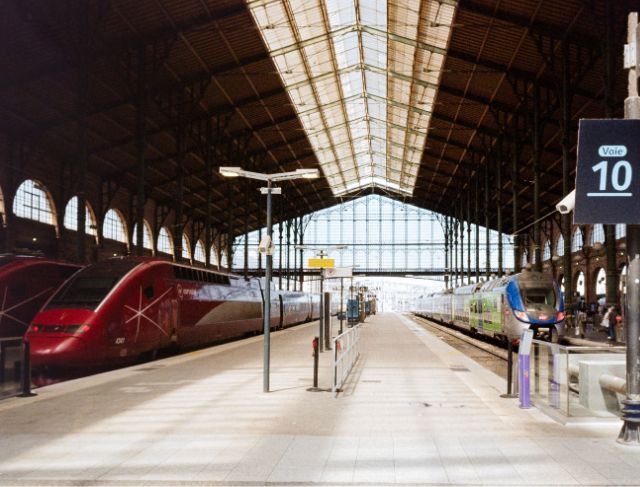

Today, hopping on a train in Europe and traveling from one country to another may seem like a piece of cake. However, things were a bit different before. If you are located in Paris, you can be in Brussels for lunch and end your day in Germany or in the Netherlands. It all sounds perfectly normal nowadays, and it is easy to forget what an impact railcars had in the past. There used to be no budget flights or high-speed internet at that time. Trains revolutionized the way people traveled in Europe.
One of the places to experience the history of railway traveling is Gare du Nord. Opened in 1864, the station was not simply built to carry people; it was an important part of the period when rail traveling was something new and associated with innovation, greatness of the nation, and economic progress.
However, the history of railways began a bit earlier, and it largely owes its development to the skill of a talented inventor and engineer.
By enhancing early steam engine technology, he invented locomotives that became faster, more powerful, and vastly more convenient for transportation purposes. His moment of success came in 1830 when Liverpool and Manchester opened.
This was not just a railway line. It turned out to be the first modern intercity railway in the world, which was fully steam-powered. Stephenson’s engine Rocket showed that trains could carry both cargo and passengers over large distances successfully.
His influence did not end with locomotives. He was responsible for the creation of the railway gauge, which would become a standard later all over Europe and in many other countries.
Railway Boom in Europe Changed Everything
As soon as Britain showed how successful railways can be, European countries rushed to take part in this process.
Belgium was among the countries to have the first railway after its opening in 1835. The state realized that railways could develop economy in the wake of independence and made transportation a state priority rather than leave everything to private companies.
France adopted a different approach. Instead of giving railway companies a free hand, the government opted for a method of supporting private enterprises with the help of subsidies under strict state supervision. Almost all railways led away from Paris, underscoring the political and cultural significance of the French capital.
Railway companies in different parts of Europe engaged in fierce competition against each other. This competition led to the emergence of new tracks but also to the construction of some of the most spectacular train stations in the world.
Why are European Train Stations Built as Palaces
If you visit major train stations, such as Gare du Nord, Milano Centrale, and Antwerp Central, you will notice that they look more like museums than actually operating terminals.
Actually, this was not a coincidence.
The companies operating railway transport were striving for imposing buildings representing their greatness to attract investments. Huge halls and enormous stone facades, considerable glass structures, and elaborate architecture became efficient tools of promotion.
For many people coming to a certain city for the first time, the railway station is the place they see in the very beginning. Companies realized that an impressive arrival could offer breathtaking impressions before people
Many of these historic stations still attract tourists after more than a hundred years.
Trains Reduced Europe
The most important change related to psychology instead of architecture.
Before trains, taking long trips needed a lot of patience. Traveling by land from Paris to Saint Petersburg around 1820 would take almost three weeks.
By the end of the 19th century, railway systems made this journey much faster and took no more than a few hours.
Cities that used to seem too distant now became available for business and mass tourism, which resulted in growth. Travelling became possible for thousands of people.
Distance became understandable at once.
Trains Even Changed Time
One interesting effect of the development of railway systems is that not only transportation but also time was changed.
Before trains, towns used local solar time, and noon was when the sun was in the highest point, which caused a difference in the time in nearby towns.
But with the development of trains and a fixed schedule, towns couldn’t use that time system anymore.
To get rid of the confusion, Great Western Railway of the United Kingdom created Greenwich Mean Time in 1840.
The necessity of railways is one of the reasons why tracking time has developed into what it is today.
The Railway History’s Unpleasant Aspects
Railroads have connected people, having turned into one of the most effective tools of warfare.
First and Second World War saw the rapid transportation of armies, guns, and munition by trains throughout Europe. Stations that once represented technological progress had become involved in numerous conflicts.
They were both that the places where children were evacuated from and stations used to transport prisoners and casualties during wars.
Wars have changed the European borders and led to strange stories related to railways.
One amazing example is the Vennbahn railway located on the border of Belgium and Germany. Due to the Treaty of Versailles, the ownership of the Vennbahn railway became Belgian after World War 1 even though it had sections on the German territory.
Transforming Rail Travel
The railway networks in Europe faced another difficulty after World War II.
The emergence of inexpensive motor vehicles and the development of aviation for long-distance trips forced rail operators to come up with an entirely different concept.
The solution was found in Japan.
The introduction of the Shinkansen in 1964 changed the world of rail transport and gave a new life to high-speed rail services in Europe, which followed the example of their Japanese counterparts. With the new system, various countries in Europe started constructing their own high-speed railway networks, giving such famous rail services as TGV in France or ICE in Germany.
It became evident that trains had to compete with airplanes on the medium-distance routes instead of competing with cars.
European trains have become even more efficient than before due to Schengen Agreement adoption in 1985.
The introduction of the Schengen Agreement decreased the number of passport inspections during the crossing of borders in the involved countries significantly.
Hopping from one city to another in Europe today seems easy.
More Than Just Transport
Railroads in Europe are something more than just metal tracks. They contributed to industrial development, popularised traveling, and created global time. They instigated political changes and changed national borders.
Any train station, bridge, tunnel, or railway represents some of this amazing history. So next time you get on a train in Europe, think that you are taking a very important journey.