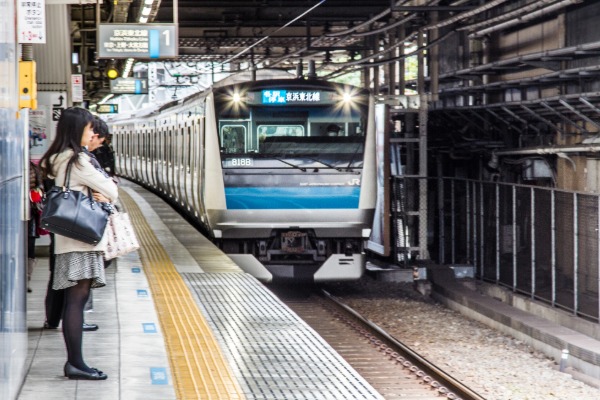

Many people have an experience to remember when they think back to their time spent in Tokyo, and that experience will be dominated by their memory of the railway system. The railway system is known for its rapid transit, punctuality, and large network of trains and subways, but long after leaving Japan, many will also likely still be able to remember one other interesting thing about the railway system—that is, the music.
At most train stations in Tokyo (and a number of other cities across Japan), you will typically hear not only an announcement and the sound of the train doors closing as a train pulls away, but a short musical excerpt before the train departs. These short musical excerpts last only a few seconds, but they are memorable enough that many travelers search out these musical selections once they have returned to their home country.
A significant aspect of each of these short musical selections is that there is nothing random about them at all; each train station is assigned its own unique musical selection to be used as the departure music for the trains.
Therefore, frequent riders and commuters who ride the train and/or take the subway frequently can associate the specific train station with the departure music; tourists also get a chance to enjoy the essence of Japan as a cultural country as well as the charm of its cultural capital through these same short musical excerpts.
What is interesting, however, is that these short musical excerpts were never meant to be created as destination-oriented attractions outside of Japan.
In the years gone by, train stations often seem like they could swallow you whole at rush hour. Platforms overflowing with people, announcements coming from every direction, trains whistling, warning buzzers buzzing (with the occasional muffle/whine), everybody rushing from one train to another with barely enough time to make it on board are all part of the daily chaos that occurs at these locations.
In an effort to alleviate some of the stress associated with getting on your train before it leaves, several companies came up with a novel approach to signalling that did not rely solely on the use of annoying buzzers. Some companies began using short pieces of music in the seconds leading up to the departure of their trains. These musical cues turned out to be extremely effective at helping passengers know when their train was about to leave without adding to the already stressful atmosphere.
The way in which musical cues help to reduce anxiety among passengers is not by adding additional stressors to the already stressful environment of a station, but rather by creating an environment where additional noise is able to be organized in an orderly manner.
The success of these musical signalling approaches spread rapidly.
As time has gone on, musical departures have become part of the daily experience of many train stations in Japan. Typically, most departutes are musically produced in a fashion so they are very short (around 7 seconds) in length, allowing enough time to warn passengers while avoiding disruption to operation.
Japan is renowned for its efficiency with its rail network, which is reflected in the timing aspect of the musical signals as well.
Minoru Mukaiya is one of the composers that has had a huge impact on how music is incorporated into modern train stations.
What makes his tale different is that he had no prior experience in the railway business. He was previously known as a musician and keyboardist in the Japanese jazz fusion music scene. His love of trains has led him to explore an entirely new area.
His unique specialty is merging the two art forms of music and railways.
Over the years he has developed and created hundreds of original station melodies for over one hundred stations in Japan. His ability to turn something as simple as a departure signal into a short story is truly remarkable.
Prior to composing a station melody; He researches the station’s location in detail.
He observes the surrounding areas, the cultural attributes and the daily users of the station. Older stations tend to reflect the traditional sounds of Japan, while those located in districts with a high number of students reflect more contemporary, upbeat sounds.
Station melodies can reflect the physical features of a train’s route.
For example; at one station, the melody’s rising pitch reflects the steep grade the train travels when it first leaves. At another station, a station melody was created from a famous anime series’ melody due to the large number of fans in the station’s neighbourhood.
The level of detail included in the creation of the station melodies is one of the main reasons for the passion train enthusiasts have for station melodies.
While some people spend their entire vacation visiting stations simply to collect an audio sample, or they create an online database of songs, or find a way to purchase merchandise featuring those same songs (shirts, key chains, etc.), there are also CDs and key chains available to listen to and collect. There are even alarm clocks that are specifically designed to wake you up with train melody songs every morning.
This may be surprising at first; however, once you experience the Japanese train system and actually hear all the train melodies, they soon become part of your daily routine. Commuters will often associate any particular song with a place, a memory or a specific time of day due to the fact that they’ve heard it repeatedly so many times.
On the other hand, people who live near open-air train stations do complain from time to time about hearing the same song over and over throughout the day; therefore, it is true that any sound can become annoying after being repeated well over 100 times throughout an entire day. However, in all other cases, train melodies generate a very positive response from the general public.
In fact, the vast majority of people that listen to the songs associate them with unique characteristics of Japanese rail transportation. They see them as a perfect example of Japanese design philosophy, which emphasizes a balance between utility and artistic beauty.
For example, a simple warning signal could have retained its traditional form as a harsh electronic beep forever, but over time it evolved into a cultural icon that incorporates sounds of transportation into the culture of local communities.
At some Japanese train stations, there’s an extra twist.
Younger travelers who are spending the night waiting for their next train may be able to pick up an ultra-high frequency sound that adults can’t hear after hours because station operators use ultrasonic devices to keep people from hanging around.
These devices use an ultrasonic sound that only someone with ears that can discern the high frequency sound could ever hear.
It’s another one of those fun little quirks of how Japan handles managing traffic in busy public places.
In addition to notifying travelers that their train is on Blissfully, the sound of the train leaving also creates a relaxing atmosphere, enhances the personality of a station, and transforms the daily commute into something you will never forget.
Hundreds of people use Japanese train stations each day; therefore, many times, a quick little seven-second tune can be used as a reminder of your time in Japan.
Ultimately, it is because of the unique nature of protecting Japan’s heritage, music, and transportation systems, that these unique little songs have become a treasured and surprising part of your journey to Japan.