
Navigating Taipei may feel like strolling through a labyrinthine neighborhood, but the experience is anything but complicated. You will turn a corner and come into a peaceful alley full of charming little cafés, historic temples, and Japanese-style buildings that appear to have been untouched for decades. Such contrast is the essence of what makes Taipei so unique among cities in Asia.
However, the city’s rich history can be discovered through layers of historical buildings dating back many centuries.
Taipei’s metamorphosis into a dynamic modern city occurred as a result of significant events throughout its colonial period and wars, as well as migration, political instability, and tremendous economic expansion; remnants of each era can still be seen all around the city of Taipei, depending on your perspective.
Before being designated as Taiwan’s capital city, Taipei was already inhabited by indigenous people from Austronesian ancestry; these groups lived on Taiwan long before non-indigenous peoples did.
Historians generally agree that Taiwan served as a location for some of the first Austronesian migration across the Pacific Ocean and Indian Ocean. The connection of cultural heritage links Taiwan to places as far away as Fiji, New Zealand, and Madagascar. The picture of ancient Taiwan looks more like a trade centre at sea compared to the image most people have in their mind today.
Taipei is located in a basin surrounded by mountains and volcanoes that make for a striking geographical backdrop. Rivers flow through the urban area, which contributed to shaping where some of the earliest settlements could be found.
Prior to being inhabited by settlers from southern China, the area that is now known as Taipei was predominantly inhabited by indigenous Ketagalan communities. As migrant communities from southern China, particularly Fujian Province, began migrating to the area in greater numbers, they typically settled close to riverbanks so that they could easily access trade routes.
This early migration led to the creation of neighbourhoods in Taipei that still exist today. Dadaocheng and Wanhua originated as major commercial centres centuries ago and are both still among the city’s most atmospheric districts today.
Walking on Dihua Street today feels almost as though you are walking through time. You will pass red-brick storefronts, overhead hanging lanterns, shops selling herbal medicine and tea, and old temples all nestled along narrow, busy streets full of life. It feels distinctly ‘Taiwanese’ in a way that giant shopping malls never can.
Tea brought about a significant change in both trade and agriculture in Taipei with great success. In the 1800’s foreign trade expanded rapidly, as the nearby town of Tamsui became a treaty port. British merchants developed a strong demand for tea grown in Taiwan and the hills surrounding Taipei became a very valuable source of agricultural products.
Realising that Northern Taiwan was potentially going to become very important from an economic perspective, the Qing Government ordered the construction of a brand new, walled city between the existing community. The layout of this walled city was to some extent influenced by the concept of feng shui, as a number of different officials designed both the city’s street grid and its walled perimeter and did so independently. This means that, when those walls were finally destroyed, there was no longer a physical representation of their influence on the modern street map of Taipei.
Following the first Sino-Japanese war, Taiwan became Japan’s first overseas colony. In contrast to many of the European Colonial Systems, the Japanese used a massive amount of their resources to build infrastructure, develop transportation networks, create education systems, develop city plans, etc.
During this time, the character of Taipei also changed in many ways. The old city walls were demolished, and replaced with wider streets, based on the designs of European cities; hence, road systems changed dramatically, neighbourhoods became re-organised, and many new public buildings arose throughout the entire city.
A great deal of Taipei’s historical architecture is derived from this period. The combination of Japanese architectural styles and European influence has created a distinctive style of architecture not often found anywhere else in Asia.
A prime example of this is the Red House at Ximending, which is still one of the best preserved buildings of this type. Built as a market in the early 1900’s, it transitioned into theatres, cinemas, and creative spaces throughout its life, and continues to provide evidence of the extent to which Japanese urban planning has influenced Taipei.
Taiwan also has an increasingly complex identity because of the multiculturalism that was established during this period. Consequently, many elements of modern Taipei embrace all of these identity layers.
You can enjoy Fujian-style noodles in a building that dates back to the Japanese era and then visit a temple that incorporates Taoist rituals and end your evening at a space-age shopping district. Very few cities could boast of a blending of identities in this manner.
The last major change in Taipei occurred as a result of the Second World War. The city was bombed heavily and when Japan was defeated, the island became part of the Republic Of China (compared with previous history where it was ruled by either indigenous Taiwanese or Japan). However, in the immediate aftermath of World War II, the People’s Republic of China (PRC) lost the Chinese Civil War (1945-1949) and Chiang Kai-Shek and the Kuomintang government retreated to Taiwan along with millions of refugees. This resulted in an increase in the population of Taipei overnight.
Due to the population explosion, there was not enough housing available for new arrivals, therefore entire neighbourhoods quickly grew out of the ground with little chance of planning or control. This rapid and somewhat chaotic growth has created an environment in which, at the same time, people can easily feel that they are in a well-planned, smooth-running city as well as in a disorganized, chaotic city.
Along the major roads and metro lines through the city, there are side streets that go for miles and are packed with apartments, restaurants, temples and small shops. Many of these side streets are very narrow and therefore some of the most interesting and nice places to visit can be found in them. Of course, getting lost in Taipei will enhance your enjoyment of this great city.
The city also has remnants visible throughout from its many years of being ruled under martial law, where it was run by an authoritarian system, before eventually becoming democratic. One of the best examples of this is Liberty Square, which has become the symbol of how the change occurred.
The Chiang Kai-shek Memorial Hall – originally constructed as a monument to honor the former President of the Republic of China (Taiwan) and to promote the preservation and celebration of Chinese culture – now serves as place for democracy protests, as well as to provide an arena for student movements demanding political reform in Taiwan. The massive plaza that encircles the Hall has become a representation of Taiwan’s tumultuous past and its currently shared democratic identity.
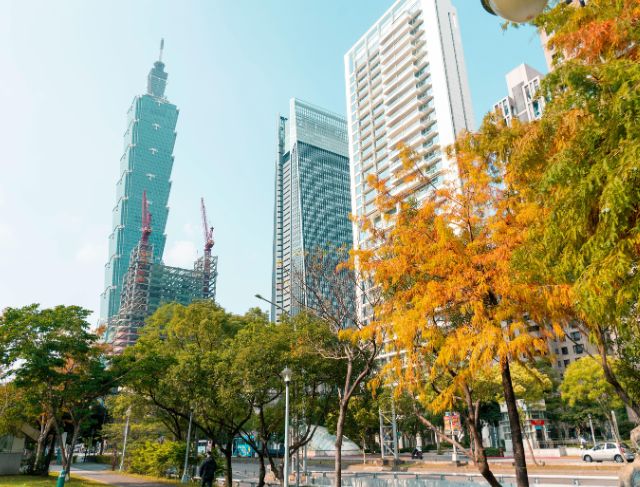
Modern-day Taipei boasts a level of efficiency and infrastructure unmatched by many other large cities. Taipei’s mass transportation system, which includes a clean, reliable and easy to use Metro (subway) that connects nearly all of the main attractions within the city, is just one example of this. Taiwan’s high-speed rail system provides easy access to all major cities on the island; bus and bike share systems provide relatively easy access to those attractions outside of the Metro system as well. In spite of the large size of Taipei, there is a feeling of safety, calmness, and hospitality that pervades the city.
Food is yet another reason that visitors fall in love with Taipei so quickly. Night markets (also known as “two for one” outlets) are found in all areas of the city, with each night market offering an abundance of specialties from all regions of the island. Simply smelling the food coming from these stalls may induce the desire to stop and eat something.
Fried Chicken, Oyster Omelettes, Bubble Tea, Grilled Shellfish, Soup Dumplings, Scallion Pancakes & Disrespect, all compete for your attention, while the colourful neon lights illuminate the bustling night markets of Taipei. Even small side streets can hide a number of incredible family-owned restaurants.
One of the most amazing aspects of Taipei is how quickly you can find yourself surrounded by nature. Within a matter of minutes, you can leave a crowded urban area and be on your way to numerous hiking trails.
City life is alive and well in a city nestled on forested hills, surrounded by hot springs, and three hours within view of mountains supporting volcanoes; Taipei feels not separated from the natural world at any time, including standing among traffic downtown.
Taipei is one of the most unqiue cities in Asia because it has retained many of its’s earlier forms. From Indigenous people, to the migration of people from China, to planning and development by the Japanese to establishing an authoritarian regime to being transformed through democracy and now into a modern technology-based city; all of these are part of the same city, giving the city such a diversity of characteristics that makes it an incredible place that cannot be easily replicated.
Some cities you visit because of their renowned structures, but Taipei will firmly capture your love by its atmosphere. When you combine the noise created by scooters and the sound of the temple bells ringing; the heat created by the humidity you have from the atmosphere; the view using the mix between the extreme elevation provided by the mountains as viewed through the different hidden alleyways; and the sheer volume of street vendor stalls selling all types of food, and you combine these things, you have a mixture that once it is burned into your memory will not leave you until you die.