
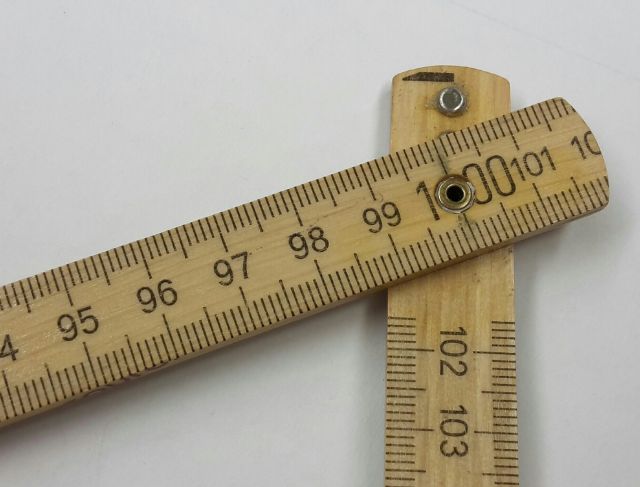

Generally when it comes down to measurement no one gives it too much thought, one meter = one meter, one kilogram = one kilogram, and one second = one second.
That’s pretty basic. However, the reason the modern world is able to function as easily due to the fact that mankind came together to agree upon an universal system of measure.
The path to realizing this goal involved revolutionary activity in France, scientists hiking vast distances in the mountains taking measurements, political upheaval, and finally a spacecraft that crashed into Mars after confusing metric measurements with standard (that’s the English/American) systems.
In 1999 NASA sent the Mars Climate Orbiter with a price tag of approximately $400 million to Mars — sadly it never made it there, and the cause for this loss was comparatively trivial. As it turns out, there were two separate and distinct engineering teams working on this project, one team using the metric system and the other using the American system as their basis for measurements.
The differences between the measurements these teams used caused the Mars Climate Orbiter to crash into Mars at an altitude that was determined to be the normal entry point, based on standard measurements, by the American engineering team; thus Mars’ gravity destroyed the spacecraft prior to it being able to complete its mission. As such, the failure of two systems that are unable to communicate with one another about their respective measurement systems results in the loss of several years’ labor and inestimable cost. Thus it is hard to imagine the enormity of such an issue, but nevertheless serves to demonstrate that standardized measurement is extremely important, and because of that, very few people realize that measurement is extremely important.
Long before modern sciences, individuals measured their surroundings using measures that made sense to them in their local area. The practice of this was very common throughout ancient history and the measurement systems of early civilizations were governed substantially by human bodies. The foot was physically the length of an individual’s foot and the Egyptian cubit came from the distance from the person’s elbow to their fingertips.
A few empires even used their emperors’ personal measurements to make basic measurements and determinations about sizes. The difficulty of having a moving target for measurement is quite obvious. The measurement for a given unit in one town could be substantially different just a few towns away; farmers who lived in the same area their whole lives were less likely to have issues with misunderstanding what they meant by the same measurement but for, merchants, travelers, engineers, and scientists, this lack of standardisation in measurements created an infinite amount of confusion.
Try to imagine trying to buy clothing, grains or tools while travelling throughout Europe. Every city had its own idea of length, weight or volume for similar products. Trade became exceedingly messy due to the lack of an agreed-to reference point for all trades.
A businessman may think they were getting a good unit price for an item when, in reality, the unit price of an item in the next town with a different definition of the same unit price for that particular item was substantially different. All measurements could be thought of as regional dialects. Business communication became excessively unmanageable.
In the end of the 1700s, when France was right in the middle of a revolution that was going to change their entire country and many thought they needed to completely rebuild their country from the ground up.
Ordinary people had been complaining that the system of measurements was inconsistent. Alongside that, scientists were promoting ideas based on logic, reason & universal systems derived from nature rather than kings & customs, which was happening during the Age of Enlightenment. Consequently, the two worlds connected at the same time.
The French scientists were creating a new measurement system for everyone, no longer using parts of body or a royal standard for measurement as used at that time. Instead of using those systems, they chose to base measurement off the Earth itself & specifically to base a meter on the length of the Earth….specifically, 1/10,000,000 of the distance from the equator to the North pole = 1 meter.
Determining the actual size of Earth turned out to be a monumental task, with French scientists traversing perilous ground between Dunkirk and Barcelona measuring angles and distances geometrically.
The project lasted for years. Political upheaval in Europe made it very difficult to complete the project. One of the team was even arrested as a foreigner (the sceptre) with a measuring device looking suspicious by locals in Spain. In spite of all of this drama, they were able to produce enough evidence on their own to determine the official meter.
Interestingly, the scientists actually made a slight error when they calculated the official meter. That is, the official meter was not completely accurate with regard to the actual dimensions of the earth; however, by the time that they realized this was the case, they no longer cared about being accurate.
What they did care about at that point was consistency. Once enough people agreed on a definition of a meter, the meter was going to work for them. This is what makes measurements so beautiful – they work only because society has collectively agreed to use those measurements.
The metric system was started by France and did not have instant approval or authorization among all European countries. Many of them continued using their traditional units of measure because they were so attached to them. A small number of nations used a mixture of traditional units and metric units until they completed transitioned to the metric system.
Over time, since science was the primary reason for standardising units of measure globally, researchers from various countries needed a common basis for comparing their discoveries, creating maps, exchanging engineering drawings, and collaborating in the development of a product.
Early in the late 1800s, countries began to work together to standardise how they measured things as a way of creating commonality. This ultimately resulted in the formation of the International Bureau of Weights Measurement located outside of Paris, which has continued to be responsible for the world’s measurements. Consequently, the metric system now encompasses many other types of measurement standards besides length (metres) and mass (kilograms). Temperature, electricity, light, time, and chemistry are just examples of how measurements are standardised today.
It is interesting that the metric system and the objects which originally defined them also evolved. The original definition of the unit of measure was an object made of metal that represented that measurement precisely (e.g., a metal bar was used for the measurement of length).
However, scientists have determined through a long period of experimentation and observation that everyday objects change (e.g., due to wear from use) and thus are an inappropriate manner of measuring things. Therefore, humanity had to create a measurement that was even more constant and stable than a metal bar stored away in a vault.
In the present time, modern definitions are related to the accepted constants of nature, such as the speed of light defines the meter and how many atomic vibrations in cesium will be a second.
While all of this seems overly complicated, the definitions of modern standards allow for the extremely precise operation of many modern technologies, such as GPS, the internet, satellites, aviation, health care and engineering.
Although most of the world continues to use the imperial system casually, many of the activities which take place behind the scenes rely heavily on metric system measurements. The United States is an official participant in the international metric system with regard to scientific research, military activities, and aerospace activities.
Moreover, even the definition of the imperial system is now derived from the metric system. Thus, unbeknownst to the majority of the population, most of the world is working from one global measurement system.
What’s curious to me is how a political revolution eventually affects the ground-level of an economy centuries later.
Revolutionary France’s demand for equal length likely would never have led to the foundation of modern day global economies like smart phones, spacecraft, global transport and the internet.
Even though it wasn’t explicitly stated as “shared standardization,” the very essence of shared standardization is one of the foundations for all life as we know it today.
It’s strange that a minor difference (inches vs. centimeters) between two units of measure created a major catastrophe for a spacecraft mission to Mars. However, it may illustrate the degree of the success of the Metric Revolution after all.
The world, in which we live, is now interconnected and technologically developed enough that a slight inconsistency can reverberate planet-wide or even to another planet entirely.
