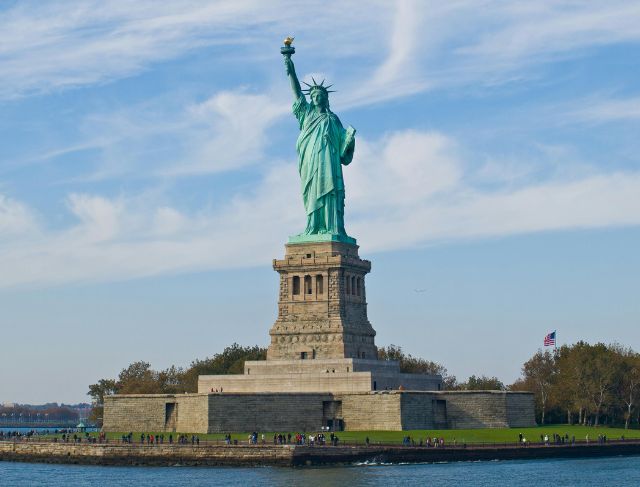

Visitors may only know so much about Lady Liberty: She’s an iconic NYC tourist destination that often gets photographed, and appears in all sorts of medium such as films, postcards, and Insta pics — or at least most of them do! But there’s actually a lot more complexity behind who Lady Liberty really is.
For starters, the history of Lady Liberty includes topics such as: immigration, politics (including the Civil War), slavery, the Franco-American War, French engineering, and an ongoing debate about how to define “freedom” in America!
Now, once we explore the history of Lady Liberty, we’ll begin changing how we perceive her from being a decorative statue to being an icon that represents all of the above topics; standing in the middle of New York Harbor representing a huge unfinished dialogue.
But before that could happen, there were several other elements in place. For instance, before the 1800s (before New York City became as developed as it is today), the southern tip of Manhattan was quite different: Forests covered the landscape over time. Indigenous communities, known as the Lenape, occupied the land for thousands of years prior to the arrival of Europeans in North America. And in 1626, Dutch colinists came to North America and established New Amsterdam on the southern end of Manhattan.
The lower part of Manhattan, where the city was located, had a defensive barrier built around it to protect against possible defenses. This later led to one of the best-known streets in the world: Wall Street.
Not only were the Dutch traders, but they were experts at taking a piece of land and transforming it with water. The Dutch filled in the shores of Manhattan, made canals and altered the land’s appearance. The British took over without much of a fight and changed the name of the colony to New York.
As time passed, the colony went from a trading post to also include the political and business hub of a developing nation. Many fires destroyed some neighbourhoods. Rebuilding was almost entirely completed using stone and steel instead of wood.
Immigration increased heavily. And also, over time, the skyline that people see today began rapidly climbing from the bottom of Manhattan.
During this time, while the United States was growing tremendously, so was the division of the country due to slavery; millions of enslaved people were forced to work under horrendous conditions while politicians debated liberty and equality.
The contradiction between America being the voice of freedom yet denying millions their basic human rights couldn’t be more obvious. Following the end of the Civil War and abolishment of slavery, our nation faced a strange time period in which it attempted to reconstruct itself with the scars of its social history.
This was the very point in time that French intellectual Édouard de Laboulaye first conceived of creating a large monument to represent freedom and liberation from slavery in the United States.
He was an admirer of American democracy and felt that a monumental statue would not only represent liberty, but also encourage democratic reforms in France. In order to make the vision of creating a monument a reality, he joined forces with Frédéric Auguste Bartholdi, an artist who had previously expressed an interest in creating gigantic monuments, and had once proposed that he erect a gigantic statue resembling a lighthouse on the Suez Canal; however, due to funding issues, that didn’t happen.
The Statue of Liberty was not originally intended as it appears today. Instead, in many early designs, Lady Liberty was shown holding broken chains, which represented a commonly understood anti-slavery message. Some designs included representations of other free slave emblems from Rome on her body.
In the late 1800s, however, the United States was still uneasy about making a strong statement with direct symbolism. Since construction funds had to come from the public, the design became progressively less politically charged, and the majority of the emancipation imagery disappeared. The broken chains were placed at Lady Liberty’s feet and partially obscured from view.
Although the symbolism changed, the engineering concepts for constructing such a large statue were still incredibly ambitious; constructing the largest statue in history was not a little undertaking.
Bartholdi required an engineer capable of designing an internal support system that could withstand both extreme weather conditions, yet still be lightweight enough to transport the statue across the Atlantic Ocean. This engineer was eventual Eiffel, long before he achieved worldwide fame for the Eiffel Tower located in Paris.
The statue was constructed out of numerous thin sheets of copper, and the copper sheets were secured to an innovative iron framework. First the entire statue was made in France as an assembly of multiple parts; then the assembled structure was taken apart and packed into crates for shipment to New York.
The statue parts could be seen before the completion of the entire monument (e.g., the arm with torch was used as part of fundraising activities in Manhattan, while the head was on display in Paris). This allowed people to see unfinished pieces of what would eventually become Liberty Island’s Statue of Liberty, well before the statue came into being.
Upon arrival at New York Harbor, however, there was a significant complication; the pedestal had not yet been completed at Liberty Island. Therefore, the massive copper components of the statue remained stored until construction of the pedestal was completed.
After the completion of the pedestal, assembly of the statue proceeded very quickly and less than four months after the assembly started, the statue towered over the harbor, permanently changing the skyline of New York City.
The statue dedication ceremony in 1886 emerged as a huge public spectacle with enormous numbers of people crowding both the waterfront and New York City to witness the fireworks over the water and the unveiling ceremony of the statue—and, finally, the assembly of the statue and its installation on the pedestal created chaos for both the statue and the pedestal.
During one of his speeches about the statue, Bartholdi inadvertently revealed the statue much earlier than intended due to misinterpreting its signal; cannons went off, crowds erupted into cheer, and the speaker became basically “lost” within the loudness of the spontaneous celebration.
However, there were those who did not agree with or celebrate the statue as a genuine symbol of freedom. Specifically, women’s rights activists criticized celebratory events since women could not vote in America at that time.
In addition, black journalists pointed out the contradiction of celebrating liberty while racial discrimination and continued segregation was all too prevalent in the fabric of American society. The statue of liberty was reflective of the idealistic vision of what Americans wished to become.
However, as time has passed, the symbolism of the statue has continued to evolve. When Ellis Island was officially opened as a port for immigrants arriving in America seeking opportunity, Lady Liberty’s symbol evolved into that of welcoming immigrants as they arrived to this country seeking a new life.
Millions of immigrants saw the statue of liberty for the first time upon entering New York Harbor. For many of these families, that first visual image of the statue represented hope, survival, and the possibility for a better life ahead.
Today, the vast majority of visitors associate the statue of liberty with immigration and very few with freeing slaves or French politics. Visitors have the opportunity to board ferries leaving Battery Park; look up to see the gargantuan statue; observe the New York City skyline from behind her; and take pictures of both the statue and skyline before they leave.
Some visitors visit crown after booking their tickets several months prior; other enjoy a great view of The Statue from the water. Free Staten Island Ferry provides some people with an image similar to what immigrants once got arriving in New York Harbor many years ago.
The Statue of Liberty has many features that make it worthy of our admiration. But what makes this monumental structure interesting is the history behind it – both good and bad. There were many ideals which inspired the creation of this structure, but unfortunately in many ways, America has not been able to live up to creating or establishing those same ideals as part of her nation. The meaning of this structure has been changed several times depending on what America needs her to represent at that given moment.
Anti-slavery, representation of a democracy, immigration symbol, National landmark, all these identities are represented within one large monument overlooking New York Harbor.
Honestly, that’s probably why it continues to be an important part of American society today. Constantly changing New York City; Statue Of Liberty has been able to observe all forms of the new city rise/fall while not participating in the change that was taking place around it, has always been there to remind us what she looks like while millions and millions go to various destinations looking for their own version of freedom and opportunity. Sailboats travel past Wall Street’s financial center.
Skyscrapers change and develop out of the skyline, while thousands of individuals continue to enter into our country in pursuit of many different types of dreams, and Lady Liberty has just stood there providing guidance as the debate regarding what freedom really means continues.