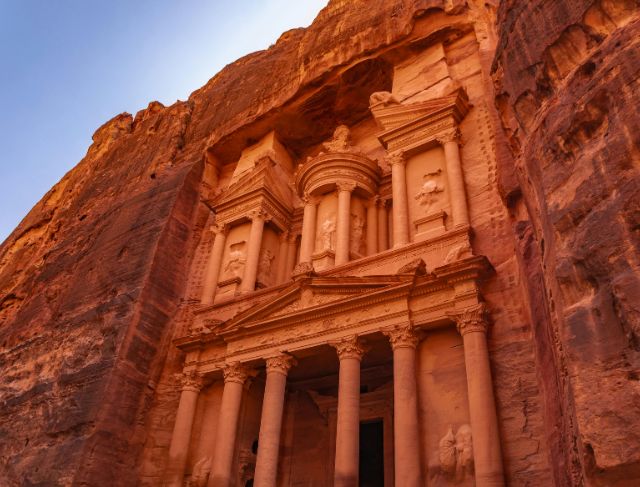

People usually think of Petra as the well-known stone structure famous for being shown in postcard and movie scenes; however, upon entering southern Jordan and moving through narrow canyons surrounded by impressive walls, they quickly discover it’s much larger, older, and more enigmatic than previously believed. Petra isn’t merely an edifice; it was once a bustling metropolis that had been carved directly out of the surrounding desert hills by one of the most astute and capable commercial civilizations in all of ancient civilization within the Middle East.
Long before visitors filled the walkways with cameras and bottled water, Petra served as the nucleus of a successful kingdom established by the Nabataeans approximately 400 years ago (B.C.) in what is now southern Jordan although at that time it hardly resembled the way it is today. The Nabataeans were skilled at adapting to the harsh desert climate. They designed systems providing water, built homes and places of worship into hard sedimentary rock, and turned Petra into a trade center that was one of the wealthiest (trade) cities in the entire region. Therefore, as merchants travelled from Arabia, Africa and again, the Mediterranean, there was little option for them other than to pass through Petra – and the Nabataeans understood how to turn those traders passing through into wealthy merchants.
peculiarly, there is evidence to suggest Petra has remained obscure to most of the world for centuries. This is part of what makes Petra unique compared to other prominent historical sites.
The beginning of the experience occurs prior to seeing the treasury. Visitors proceed through the siq, which is a winding canyon lined with smooth walls that rise sharply. As you walk through the siq, it seems like you are living out a movie scene — at every turn, the anticipation for your discovery increases. You begin to discover small carvings, ancient irrigation water channels etched into stone, and relics of antiquity will appear on the walls throughout your trek, until finally arriving at the end of the siq and at last seeing the famous facade of the treasury.
This moment is what every visitor has worked so hard for. The treasury comes into view as you pass through the last turn of the siq illuminated with a brilliant hue of orange and gold depending upon the position of the sun.
Many travelers are surprised to find that there is much more to Petra than just the Treasury of Petra. Some visitors arrive, take their photos, and leave too soon, not realizing that the archaeological park of Petra is enormous, with tombs, temples, caves, stairs, and ancient streets filling up the surrounding landscape. The Monastery is located at a distance at the top of a long climb up a hill where there are wonderful views of the desert once you reach the top.
The Monastery is one of the most rewarding sites in Petra. Climbing to the Monastery can be challenging (especially during the hot summer months) but every step up the mountain is worth it to experience the beauty at the Monastery. Especially in the late afternoon when the clouds move to give you a beautiful view of the mountains below.
Petra’s placement was purposefully done to provide natural defenses against enemies because it is positioned amongst cliffs and narrow passages that are difficult to navigate. The strategic location of Petra along major trade routes also provided a constant flow of caravans transporting spices, woods, textiles and other valuable goods.
Though the surrounding area appears dry and harsh by present day standards, the Nabataeans engineered a system of dams, reservoirs and aqueducts to capture and store water during seasonal floods. Without their ingenuity and advancements, it would have been impossible to have created a city of this magnitude in such a harsh environment.
Years later, in the early 1800’s, a Swiss explorer named Johann Ludwig Burckhardt was instrumental in rediscovering Petra and bringing it back to the attention of the western world. Under the guise of being a traveler, he disguised himself and persuaded a guide to take him through the canyon by claiming he wished to visit a holy site connected to Aaron (the brother of Moses). Once Burckhardt reached the city, he kept a secret record of everything in his journal until he returned to Europe.
Petra is one of the top attractions in Jordan today but requires preparation in order to visit. Desert temperatures can be extreme during the day particularly in the summer months. Strong walking shoes, sunscreen, water, and lightweight clothing are required if you plan on walking anywhere between several kilometers to the entire site of Petra. Many people also opt to stay in Wadi Musa overnight so that they can enter Petra early in the morning before too many other visitors arrive.
The best time to visit Petra is just after sunrise. The sunlight changes and reveals the colors and textures of both the canyon walls and the sandstone structures that make up Petra. The cooler temperatures of the morning provide a better environment to hike around Petra than do the warmer temperatures of midday.
Additionally, a candle-lit night tour offers visitors the opportunity to view both the Siq and the magnificent Treasury in a unique light. The tranquility of this nocturnal setting and the cooler temperature creates a very different “feel” than visiting Petra during the heat of the day when it is bustling with people. The daytime visit provides an excellent opportunity to admire the beautiful architecture of Petra and to appreciate the surrounding landscape, whereas visiting Petra at night evokes more emotion than does a visit during the day, because of the overall mystery of the site.
The reason Petra is so remarkable is not just because of the amazing architecture, but because you can feel the presence of an entire civilization that once thrived in these mountain valleys. You will walk through the caves where families lived, see the ancient route taken by traders hundreds of years ago, and stand next to structures that were built around the same time that these empires were established and have been standing ever since. There are very few places on earth that combine the elements of history, geology, and atmosphere as beautifully as Petra does.
Even after spending hours walking around Petra, the entire site continues to provide a feeling of incompleteness and the presence of hidden treasures waiting to be found somewhere in the sandstone cliff formations of Petra.