
Berlin has an unfinished feel to it; a glorious incompleteness. While many cities work to give off a polished image, Berlin appears to celebrate its imperfections and proud of its features that are cracked, devoid of buildings, slobbering with graffiti, juxtaposed by old and new buildings.
Take a walk around for an hour and you will see something interesting about Berlin – the city doesn’t conceal its history! Rather than hide its history away, Berlin has kept those aspects of history visible. You can easily find remnants of Berlin’s history lying in the city as visible reminders.
Prior to it being a world-renowned Techno town and creative hub, Berlin was historically separated into two towns on either side of the Spree River. The two towns to this day grew into one unit and were connected to each other by the castle walls that were built at different times as a form of fortification and protection from wars, thus forming the structure of the town. Even though the walls have all been removed from the majority of Berlin centuries ago, the shape, outline and design of the walls built so long ago is still reflected in the design of modern-day Berlin’s roadways.
As seen on old maps from the beginning of the 19th century, Berlin was compact; however, with the arrival of the Industrial Revolution this once compact city would become more than double its size. Factories began popping up everywhere, railroads connected different areas of the city together, and masses of workers flocked into Berlin in search of work. Almost overnight Berlin changed from a regional capital into one of the largest metropolises in Europe. The population of the city expanded so quickly that entire neighbourhoods were created outside the first customs wall, altering the character of the city forever.
Modern-day Berlin’s chaotic characteristics began developing during this time. Eventually a vast urban landscape emerged, as Berlin absorbed its surrounding towns and suburbs into one continuous city. Many existing districts that are currently distinct from one another were originally independent towns with their own town centres, streets, and localities; this helps explain why sometimes, in Berlin it feels like you are in a different city when you go from one part to another.
Then came the dark days of Berlin. When Hitler became Chancellor, he had plans to turn Berlin into the capital of a new empire – a massive capital. Adolf saw the city as disorganized; he wanted to redesign Berlin to be monumental and build “Germania”. Hitler envisioned wide boulevards, large arches and huge buildings to represent both power and dominance over Germany’s enemies. Demolishing large portions of the city was to give way to these new projects.
To show just one remnant of the immense architectural ambitions of those days is a large concrete cylinder built to determine if the soft, swampy ground that Berlin sits on could hold the weight of a proposed triumphal arch by Hitler. The massive structure intended to be built never took place; however, the test structure still exists and continues to be a silent reminder of a different time and place.
Berlin’s landscape and topography help explain all of the city’s characteristics. Berlin is very flat there are many rivers, lakes, wetlands, and soft soil. The wetlands in the area influenced the layout of transportation and construction. In addition, there are many parks and open areas throughout Berlin because of the landscape and nature and all the things nature does in Berlin to try and reclaim the land.
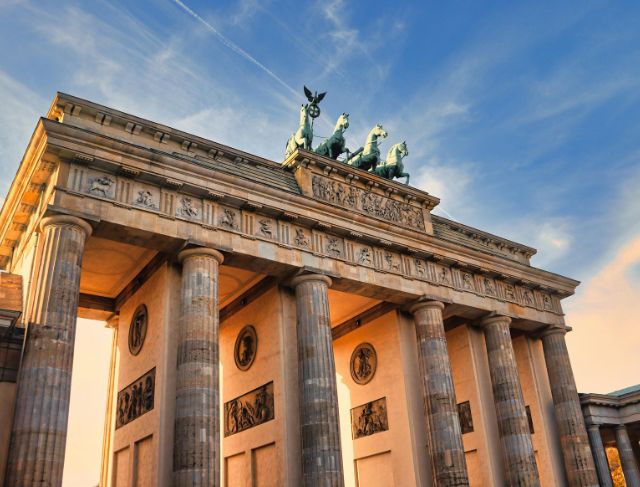
Berlin experienced huge upheaval post-WWII and it is hard to picture just what occurred. Much of the city centre was destroyed through bombings with some estimates claiming that about 80% of central Berlin was in ruins after the end of the war. The pictures of how things looked in Berlin after the war appear quite unrealistic compared to today. For instance, one of the world’s most famous structures (the Brandenburg Gate) managed to escape destruction, while the thousands of ruins extended behind it.
The aftermath of WWII was even more devastating than what had happened prior to the end of hostilities. Berlin was one of the most divided cities in history with two distinct political factions controlling the two halves of the city. The eastern side of Berlin was governed by East Germany, while west Berlin was controlled by the Western allies. Another thing we often overlook is that West Berlin was entirely surrounded by East Germany, thus making it an isolated island completely surrounded by Soviet occupied territories.
Finally, the Berlin Wall was erected.
Many people picture the Berlin Wall as simply a wall of cement separating East and West. However, the wall was only the most visible aspect of a much larger security zone which included guard towers, perimeter fences, patrol roads, dogs, floodlights, and a deadly no man’s land between the major barriers. Entire neighborhoods were cut off from one another almost overnight; families suddenly found themselves separated from each other; even churches, streets and cemeteries were sliced in half by a wall, fences and barbed wire.
East Berlin, under the influence of the Soviet Union, created a very different Berlin than did West Berlin. East Berlin created a unique socialist architecture featuring wide boulevards lined with magnificent yet utilitarian buildings such as the Karl-Marx-Allee developed to impress workers with the sheer size and organisation of their surroundings. Conversely, West Berlin was hampered by its location behind the Iron Curtain, therefore making it much more difficult and time-consuming to get supplies for rebuilding after World War II. As a result, West Berlin underwent a slower and less systematic development than any other city in Europe.
One of the most fascinating elements from this era linked to present-day Berlin is Tempelhof Airport which was used as a base during the Cold War to provide food, fuel, medicine and supplies to the residents of West Berlin via either military or commercial airlift. At times, planes would land at Tempelhof almost every minute during the Berlin Airlift. Today, Tempelhof has been transformed into an enormous civic park for biking, kite-flying, running, picnicking, etc. – everything that was not possible during the Cold War because of its former association with global power struggles.
This transformation manifests Berlin’s character. The city consistently converts its historical trauma into new creative and lively ventures. Vacant and unused factories are repurposed into creative venues. Abandoned bunkers have been remodeled into cultural spaces or museums. Previously vacant lots have transformed into community gardens or memorials. Berlin has yet to remove all evidence of its suffering, but rather builds around those places.
Today, Berlin is vibrant, rebellious, and welcoming. Its nightlife continues to be world-renowned, its culinary offerings create new outlets each day, and every neighbourhood in Berlin has its own unique character; from sophisticated districts filled with shiny and expensive businesses to rugged, less developed areas. All of these factors combine to create an extremely authentic experience in Berlin, unlike other tourist destinations.
Perhaps this is why visitors feel such a strong connection to Berlin. Berlin does not attempt to portray itself as a perfect place; it has survived war-related damage, partition, occupation, political turmoil and continual re-creation throughout its history. Therefore, all street corners have multiple memories beneath them.
Although Berlin is evolving, it is precisely this unfinished quality that makes it an enduringly memorable place to visit.