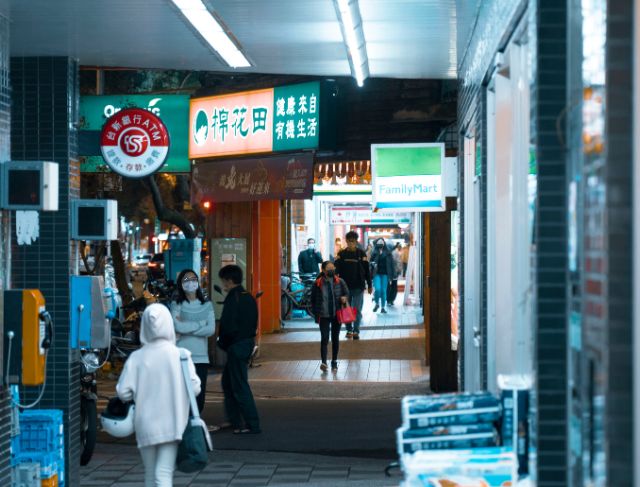

While most non-Asians think of a convenience store as merely a place to grab soda, snacks, or hopefully less-than-pleasant, maybe-warm hot dogs slowly rotating under a heat lamp, when they get to Japan and walk into an average 7-Eleven at midnight, they quickly realize that their whole life has been a lie. In fact, the “konbini” provides such a dramatically better experience regarding convenience than supermarkets that they change how we think about convenience stores altogether.
The biggest surprise that travelers experience when they visit a konbini is actually the feeling and atmosphere of the store rather than the food itself. When you approach the automatic doors and enter the store, the doors slide open, and there’s usually soft music playing just loud enough that you feel relaxed. The shelves are all organized so perfectly, and everything just feels serene despite the chaos of the city around it. Every konbini is a restaurant, a rest area, an emergency kit, and a cultural experience no matter where you are located in Japan, be it in the busy metropolitan areas such as Tokyo and Osaka or in some tiny Japanese mountain town.
Convenience stores (konbini) in Japan become very much like social hubs after dark where students stop by following their gaming all day, office workers get warm “ramen” noodles before heading home to catch the last train, visitors sit and enjoy “coffee” in a can (Japanese-style) while discussing with local people who will be sleeping on the ground until Japanese train service resumes in the morning are all reasons why convenience stores provide a very social place to meet and catch up with friends. Once you add in the fact that most people can sit down and have a bite to eat or some drinks at the same time, it makes for a very positive social experience.
Interestingly enough, although the original concept of a 7-Eleven originated in the United States, 7-Eleven did not intend to have a major cultural effect on Japan. Back in the 70s, while Japan was becoming a very industrialized nation it was still very old-fashioned when it came to grocery shopping. Most families made frequent trips to buy fresh products because their kitchens and storage areas were very small. Therefore, there were local grocery stores where most people would shop compared with the larger-sized supermarkets that had taken over by then, Convenience stores took advantage of the current culture.
During a visit to the U.S., Toshifumi Suzuki saw the American convenience store chain, 7-Eleven and believed the concept would work well in Japan. He negotiated with the company to open the first 7-Eleven in Japan, a converted liquor store. Although the store became popular, operating costs were still too high for the store to be profitable.
Rather than giving up, Suzuki began refining all aspects of the business. He adjusted inventory levels frequently. Distribution improved beyond any previous expectations. He implemented new technologies that helped lower shrinkage and improve the speed of stocking shelves. Each small detail was taken into consideration. Over time, Japanese convenience stores expanded well beyond the original American model and evolved into something completely different.
While Japanese convenience stores prospered, the American side of the business suffered due to financial difficulties, competition from gas stations and corporate debt. The parent company of 7-Eleven was on the verge of bankruptcy when the Japanese company that created 7-Eleven purchased a substantial stake in the American company. In one of the most unique twists in business history, the Japanese version of 7-Eleven ultimately saved the original brand.
There are convenience stores usually on every corner within Japan. Often times, you can find as many as 3 different convenience store chains (i.e. 7-Eleven, Lawson, and FamilyMart) vying for business in the same neighborhood with one or more chains having established a loyal following. Depending on whom you ask, every convenience store chain is the best chain, so you could very easily start a lively discussion.
The primary reason that tourists come to love the konbini culture is for the food selection. The food selection is seemingly endless, as it includes such items as freshly made onigiri (rice balls with fish inside) to noodles to crispy fried chicken to egg salad sandwiches to seasonal desserts to pasta – they all taste as fresh as they look. Many tourists come expecting to find cheap snacks only to be surprised that the food found in the convenience stores has a higher quality than what you find at home in the airport food court.
Visiting a konbini in the wintertime can be even more magical. They will have oden (meat, fish, and vegetable stew) pots steaming inside the store filled with fish cakes, tofu, radish, and boiled eggs soaking in warm broth. People warm themselves while drinking hot soup and tea after coming in from the blizzard and continuously changing seasonal menus giving the appearance that each visit will be a little bit different than the previous one.
Many people have a strong attraction to the desserts sold at convenience stores, such as Japanese cheese cake, melon bread, custard pudding, fluffy cream sandwiches, etc. These types of foods have reached a cult-like status on the internet. The moment new seasonal products are released, social media is flooded with posts about them. One week everyone is posting about strawberry desserts, the next week sweet potato desserts will be the hot topic of discussion, and the following week people will be sharing posts about sakura-flavoured sweets.
While foods at convenience stores are very popular, the convenience factor is actually one of the main reasons for their success. Convenience stores serve a similar purpose to miniature service centres. They offer a variety of uses. Convenience stores allow customers to pay bills, print, buy concert tickets, withdraw money, reserve museum tickets, recharge public transport cards, and ship parcels at one location.
International travelers also find convenience stores help with many of the common problems they face while travelling.
They are helpful in a practical way, especially for international visitors because the ATMs in Japanese convenience stores tend to accept foreign cards much better than banks do. So, a visitor can get their breakfast, pay their phone bill, print out their directions to their destination, and pick up their train tickets all in less than ten minutes.
Visitors from outside of Japan often remark about how comforting the konbinis are at the airport. When people are arriving in a new country and have jet lag, they often feel comfort through the konbini because they provide a more familiar atmosphere than anything else they experience in the new environment. The people that work in the konbini are generally very friendly and willing to assist each customer in a timely and professional manner. Tourists often recall their experiences from the konbini long after they have forgotten about the more expensive sights and places like hotels.
The way that konbinis in Japan are different than other convenience stores in other countries is because of the attention to detail provided by the Japanese. There is nothing random. Everything is arranged in an organized manner. The shelves are immaculately clean. Hot foods, cold drinks, and fresh products are consistently rotated on the shelf to ensure they are still fresh. Even the sandwiches are arranged with a surprising precision.
In addition, another reason why convenience stores are so different in Japan when compared to other countries is because of the overall safety of visiting the konbini. Customers in other countries may feel uncomfortable visiting the convenience stores late at night and rushing through their experience due to the fear of being in an unsafe area. However, when customers in Japan visit the konbini at two o’clock in the morning, they are usually just going to get snacks, coffee, or dessert with no concerns. Students study at the konbini; workers rest at the konbini; travelers rejuvenate at the konbini).
Japan is home to many amazing restaurants. Also, many travelers can discover the best restaurants when they first land in Japan — typically in a konbini (short for convenience store) — where they likely try their first onigiri (rice ball), realize what canned milk tea is, or (most likely) get hooked on egg sandwiches at some point. These experiences are everyday occurrences but become some of the most memorable travel moments for visitors to Japan.
Once you’ve visited Japan a couple of times, you will find you’re on a sort of strange routine. Each morning starts with your first konbini (Japanese convenience store) coffee, followed by lunchtime at a konbini, stoping by a konbini for snacks before heading home from the train station, and ending your night with a bag full of random desserts you ended up buying while at a konbini. The konbini experience is woven into the entire trip to Japan.
Therefore, it’s no surprise that so many travelers develop an emotional attachment to konbini stores because they offer so much in terms of practicality, affordability, and reliability. Most surprising is how they also have such a cozy feel — not only do you get to purchase items at a konbini store, but they also become part of your trip to Japan.