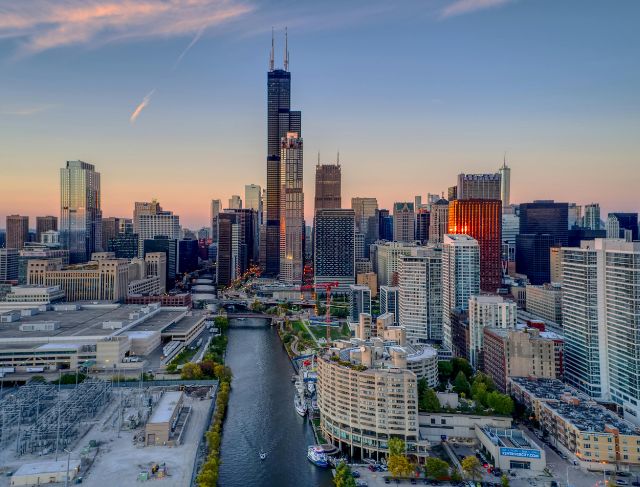

Before Chicago became known for its skyscrapers, subway systems, and busy streets, it originally consisted of many swamps and wetlands, riversides, and wide-open spaces surrounding a muddy river. Today it is hard to visualize that one of the largest cities in the USA was once a remote settlement located next to a river filled with wild onions.
Chicago now seems almost too large to comprehend, covering vast areas of land, containing thousands of buildings, and bustling with activity and energy. However, the true amazement of the city is how quickly it has grown from nothing to being one of the largest and most significant cities in the world.
The river’s opening made all the difference to the development of the city of Chicago and to the surrounding area. The Chicago river was the shortest path from the Great Lakes to the Mississippi river system, providing easy access for traders to send and receive goods throughout North America, which made the area very valuable. The area was used as a major trading route for many years by native peoples before the arrival of white settlers.
Some settlers and traders saw an opportunity to come to Chicago as well. One Haitian-born trader, Jean Baptiste Point du Sable, established a settleme near the mouth of the Chicago River, and is recognized as the founder of Chicago. Later the U.S. Military built Fort Dearborn to have better control over the area because of the rapid movement than ever.
Canals and much-needed infrastructure were being built throughout the United States, when all of a sudden there was a surge in growth in Chicago. After trade connections were made between the eastern part of the United States and the Great Lakes through the Erie Canal, it filled in a lot of the last pieces that made it a total transportation network. As a result, businesses came in, and many people flocked to the Chicago area in search of new opportunities as a result of the rise in land values.
The amount of growth in this area was literally unbelievable. Just weeks earlier, it was still almost entirely undeveloped land, and now a total of over a million people live in it and thrive as an international business center. The railroads, shipping routes, warehouses, factories, and slaughters houses made Chicago a true magnet for both workers and investors.
Chicago experienced a number of serious problems as a result of its tremendous growth over the years. The first serious issue is the city’s extremely flat land. Though this seems innocuous, flat land is difficult to drain—a very serious issue for a city that collects a significant amount of rainfall. Water did not drain from the streets to the sewers, and sewage systems only occasionally worked. Subsequently, diseases spread quite easily through polluted sources of water.
To solve these issues, City officials enlisted engineers from around the world to devise an “urban engineering project” that no city had attempted before in order to make a permanent solution. Engineers will repeat the effort all over again, but to a lesser degree.
The city has begun to lift entire buildings, complete hotels, and full blocks of Springfield, Illinois, dozens of feet above the ground using huge jackscrews. This project required hundreds of pylons and thousands of jackscrews to accomplish.
Although the project was successful in elevating large portions of the city above the flood waters; it became apparent that there was still a significant risk of flooding due to sewage flowing directly into the Chicago River. The Chicago River is also the primary source of drinking water for the City of Chicago. Therefore, city engineers developed an alternate solution by reversing the flow of the Chicago River.
Rather than draining into Lake Michigan, the river was rerouted into the Mississippi River System using an Artificial Canal. The project created a solution to Chicago’s sanitation issues while also making all the cities downstream very disgruntled. Regardless, it went down in history as one of the largest engineering feats in American Urban history.
The Great Chicago Fire destroyed huge portions of the city in 1871, including many downtown areas. Wooden sidewalks, buildings made of wood, and dry weather allowed flames to spread easily through the city. Hundreds of families lost their homes, thousands of businesses were destroyed overnight, and millions of dollars were turned to ash.
After the fire, architects and engineers approached the rebuilding of the city differently. Using much stronger materials, the introduction of steel-frame construction, and many new ideas in architectural design created a new, innovative approach for Chicago, making it a testing ground for the modern building. Eventually, this rebuilding period allowed for the creation of the world’s first modern skyscraper.
Skyscraper innovation in Chicago became intertwined with the city as it evolved into one of the most recognizable skylines in the world. The addition of the Sears Tower — now known as the Willis Tower — in decades later multiplied the city’s ambition for height. It was the highest structure in the world and showed just how committed Chicagoans are to engineering and size.
The layout of the city tells a remarkable story. The grid-like system of Chicago helped the city organize rapid growth, however, the diagonal roads that are older than the grid cut across the map at odd angles. Many of those older roads actually trace the routes of the ancient Indigenous people before modern streets were designed.
Confusion soon ensued as Chicago began to grow away from its core. As communities surrounding Chicago were absorbed into the city, street names repeated regularly. Imagine trying to deliver mail in an area with over a dozen different streets that are all named “Washington.” To alleviate the confusion, Chicago developed an entirely new addressing system using State Street and Madison Street as the focal point of the new address system. The City still uses this numerical grid system to organize even the modern day.
During the World’s Fair in 1893, Chicago became an international cultural epicenter. The exposition created the so-called ‘White City’ in the area that became the site of the ensuing fair: a series of large, classic buildings that shone bright with electrical illumination. Many visitors could never imagine that there was nothing but imagination.
The fair was instrumental in influencing and shaping many of our current perspectives about urban design, architecture and public spaces, and introduced many ideas that eventually led to an improved sense of community in urban centers. The fair also introduced the world’s first Ferris wheel indicating that there was no way that Chicago would be limiting itself in its future.
In modern-day Chicago, all eras of the city still exist in harmony. Although the river remains a central part of the city’s culture, the areas bordering the river now almost completely line the river with restaurant districts, walkways and bridges. Where there were once rail yards, Millennium Park now occupies that space. The dramatic Cloud Gate (also known as The Bean) shows the impressive urban skyline that has evolved over generations.
For generations, the bridges of Chicago have been raised for passing boats just as they are raised. These movable bridges continue to provide both an element of function in an industrialized manner as well as to represent the new arrival of beauty into the everyday landscape of Chicago and provide additional character to the city’s overall personality.
As Chicago becomes more apparent during exploration within the city; through various examples such as the creation of buildings, the reversal of rivers, rebuilding after fires and the invention of skyscrapers, they all sound unattainable until you see that Chicago has accomplished it all.
This probably explains why Chicago has a sense of uniqueness compared to the rest of America. Chicago has not been created gradually but has been forced to come into being through ambition, engineering and upheaval; constantly reinvented.