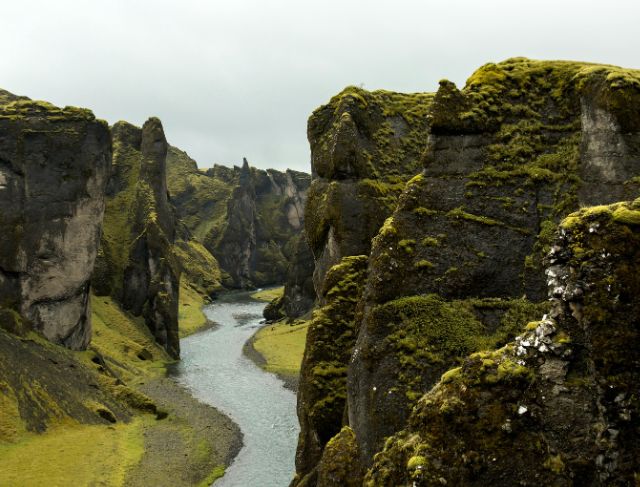

Places that have the ability to completely change our understanding of what “nature” is are rare. However, Iceland is one of those places. It doesn’t redefine what nature is in ostentatious or grandiose ways, it does it in much more understated and almost surreal ways, where the falls seem to be painted, the earth bubbles with steam from below like there’s a film crew nearby, and the entire topography of the region seems so new, it’s like the earth just made it yesterday.
Usually starting the trip is in a place like Reykjavík, where you feel calm and relaxed in a small compact city rather than over stimulated and stressed out by larger cities. Reykjavík is not going to be trying to compete with the large, loud capitals. Instead they put more of a focus on their charm and uniqueness. With many small, narrow streets, quaint cafés, and a beautiful, very modern church that appears to have been formed out of volcanic rock rather than some man-made construction, this creates the conditions that allow you to start to slow down even before your adventure has begun.
You may have heard of the Golden Circle, a simple term used by many people to indicate the loop that contains the majority of Iceland’s great natural attractions in easily accessible locations. It’s not any type of officially recognized region, and it’s simply an easy way to create one big loop around some of Iceland’s biggest spectacles without having to navigate all over multiple areas of the country.
The Golden Circle has historical significance beyond being a fun way for visitors to quickly see Iceland’s highlights. The most obvious example of this is in Þingvellir National Park. In Þingvellir National Park, Iceland’s parliament was established over 1000 years ago and is where today, the earth is separating two enormous tectonic plates. Essentially, the earth is separating continents under your feet, which makes this one of the unique places to experience the blending of both human history and geological time.
The ground changes dramatically not far from here. A crater known as Kerið appears. This crater is relatively new in the landscape of Iceland (it is only 3,000 years old), compared to other natural features, which means that its colours have not yet been obscured by earth. The red rocks that surround the turquoise blue water contrast in a way that makes it seem as though the colours have been enhanced using photo editing software. However, this crater is natural and you can walk down to the water’s edge.
Then there’s the moment that the ground starts to breathe. That is the geyser area. The original Geysir (which is how we got the term “geysers”) is mostly quiet now, but next door, Strokkur puts on quite a show. About every three or four minutes the ground plays host to the bubbling water that precedes a huge, boiling eruption of water coming up from beneath the surface without warning — just pure power being repeated. You do more than watch this; you wait for it — as if it is a natural theatre production that will always be enjoyable.
Then just when you’ve had enough, the whole thing changes into something a little more gentle but still very much moving; essentially, when you’re at Gullfoss – aka ‘Golden Falls’, not only do they pour water into a big canyon, but the waterfall makes many, many folds and makes a lot of noise as it rolls the glacial water down this large canyon below. On certain days, when the mist rises up from the ground it catches the sunlight at just the perfect angle, and the whole area looks like it’s glowing.
Somewhere in between all of these stops, another different type of experience is out there waiting – one that has nothing to do with hiking or having a viewpoint. Hot springs. Not the overly manicured, very busy hot springs that you may have seen on social media, but the much more quiet hot springs where the hot spring actually belongs there. The Secret Lagoon is one option; it is simple and historic, having been used since the late 1800’s. If you walk a little bit off of the main road, there are natural hot springs in the hillsides where you can really experience something different…less structure and a lot of quiet.
Interestingly enough, none of this was ever meant to be a tourist trail. The tiny villages along the way were not created for tourism; rather, they existed as settlements and adapted to being a destination for visitors. Over years, guesthouses, lodges, and roadside stops have transformed this circuit into one of the best ways to experience Iceland while staying close to home.
Perhaps that’s what makes Iceland so attractive. While it does allow you some structure to get started, it leaves the rest to the landscape. For example, you can walk between two continents one minute and the next you can view boiling water shooting up from the earth, and next you are relaxing in a secluded hot spring in the middle of beautiful, unspoiled countryside.
Iceland is not a place for rushing to see sights. The map does not reflect what is experienced along the route; the map only shows how far apart they are from one another. The experiences in Iceland, no matter how far apart they may appear are all part of the same experience.