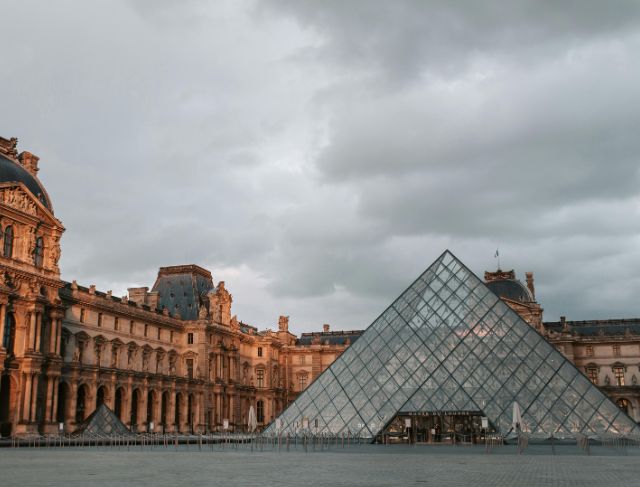

For those people saying that change is bad for history, then they ought to check out the Louvre. The Louvre has served many purposes and, therefore, has had different identities during its long lifetime – from fort to palace to museum to international icon (which is what it is now, thanks to the fact that there is a glass pyramid in its courtyard).
That glass pyramid is not just an entrance into the Louvre, it is the continuation of an epic 800-year old story. The Louvre has continually changed based on some influence from whatever era it is going through in its life cycle, making it impossible for anybody to give an accurate history of it.
During the 12th century, the Louvre wasn’t based on art (like it is today). It all started as a fortress built to protect Paris because of the lack of size Paris held at that time and because of all the attacking troubles it had due to being the capital of France (before it became the Louvre). The Louvre was built with high walls around it to provide a place for refuge and a place to survive.
As Paris grew larger, the fortress began to decline in value. With the shift in power from a military stronghold to a site of comfort and security, new uses for the site began to take shape in the 1500’s. Though some would see this as part of the royal residence’s ongoing metamorphosis from military use to residential property, it is important to note that the entire process was not completed until the kings had completed various renovations and modifications over the years. By modifying the building with new wings and redesigning portions of the interior space over many generations, ultimately the conversion into a royal palace had occurred.
Upon deciding to move away from the palace to reside in Versailles in the 1600’s, Louis XIV left behind an extensive collection of artwork that ultimately served to create the content that exists at the Louvre today.
As the monarchy ultimately fell away, those items which had belonged to the royals became available to the public. The Louvre transitioned from a place where only royalty could enter into a museum, thereby creating for the first time opportunities for individuals outside of royalty to experience the places that used to belong to royals and creating a new, cultural identity: Access to previously elite culture became accessible to everyone and to build a common heritage through shared experience and culture at a single location (the Louvre).
More than one ruler made the Louvre bigger and more ambitious throughout history. At one point, another palace was supposed to be built close to the Louvre, and subsequent construction of the two would connect them together. This construction project lasted several hundred years – a truly monumental undertaking lasting through generations.
One of the most notable developments of this period was the longest art gallery in France; it was bold in design (oversized) and represented the might of the French monarchy.
By the end of the 19th century, an uprising left the second palace in ruins. Rather than re-creating the second palace, the government chose to keep the east side of the Louvre open. This single decision changed the overall look of the Louvre, giving it its distinctive U-shaped footprint.
There are a very large number of creative works in the Louvre collection, dating back thousands of years across literally thousands of creative expressions by people all over the world. Since such a large number of creative works exist, viewing every one of them in one visit is an impossible undertaking. At the Louvre, you never “finish” viewing it; you will always have parts of it to explore.
By the way, the Mona Lisa is located at the Louvre. Although her size is smaller than many people expect, she draws nearly 9 million visitors each year.
Besides what’s actually in the Louvre, it also has a number of interesting connections to the rest of Paris. For example, there is an invisible line, often referred to as the historical axis, that runs through the city of Paris linking the city’s most famous sites in a straight orientation. The Louvre is located along that historical axis, and the orientation of the other monuments along it.
The placement of the statues and other structures throughout the courtyard area is aligned to the historical axis as well. Nothing has been placed randomly; even under the most recent renovations, respect had to be shown to the decisions that were made hundreds of years ago.
When the pyramid was first introduced in the late 1980s, people’s reactions were not positive. A modern, clean, and contemporary structure was placed in front of the historical palace-type structure of the Louvre (which people tend to view as being out of place). Over time, the drastic difference between the two structures has become a defining element.
Old stone walls signify many years of experience. In contrast, glass reflects new methodologies and ideas. And rather than being in conflict, both elements work together. This indicates that cities don’t need to make a decision between the past and their future.
The Louvre Museum exhibits more than art; it is an alive museum on how history has continued to build upon itself over years. Every monarch who ruled, every revolution that occurred, and every builder left something for the next generation. Rather than erase what was previously built, Paris simply built upon it.
When you are in the courtyard of the Louvre and see a glass pyramid, you do not see two different styles of architecture.