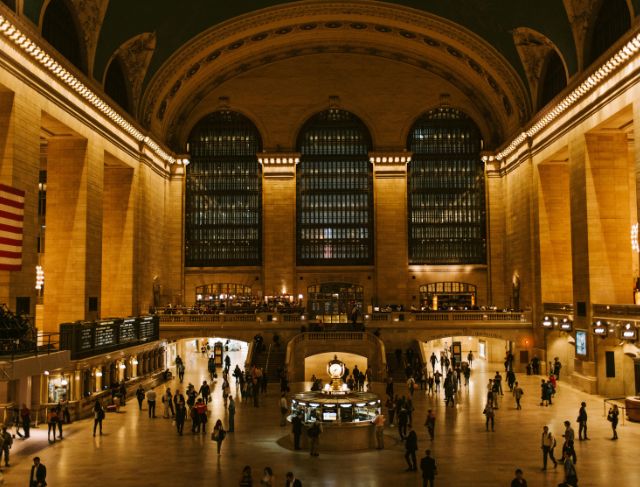

Grand Central Terminal is a good place to rush to catch a train and leave without any knowledge of how close it was to not existing at all. The most exciting part about Grand Central Terminal is that it almost didn’t survive. But today it is located in the heart of Manhattan, continuing to function daily while housing much more history than is typically noted.
Before anyone looks up at the famous ceiling of Grand Central Terminal, there are many things occurring under the main level of the building. There are hundreds of train tracks extending below the main level, much more than you would see if only looking at one large level (the main one). The structure is a vertical maze containing almost nine levels below ground. There is a never-ending flow of trains in and out of Grand Central Terminal that connect all the areas of the city in ways that you cannot typically see until you take time to think about them.
As you enter into the main concourse, the atmosphere of the space slows down, expands and changes sounds. Suddenly, there’s this unbelievably detailed ceiling painted with the constellations; soft golden and blue colors give it a dramatic effect. It definitely does not feel like a typical transportation hub, but rather a purposely designed space that could have been created for a play or movie. People do not just pass through the concourse, they stop, look up at the ceiling, take pictures and spend more time than they originally intended.
The center of all this activity is where you will find the clock. This is not just any clock, but one of the most recognizable clocks in New York City. It is suspended above the information booth in solid brass and quietly worth a fortune. People meet at the clock while waiting to meet someone. Most likely, they do not know that this has become an iconic place over time.
Many years ago, Park Avenue wasn’t a clean street as it is now; it actually was a packed rail yard with tracks on the surface. The entire area was operated more like a chaotic rail yard than an urban center. It was not until the end of the 1800s that the tracks were covered and this area became more structured, which led to the establishment of Grand Central Terminal.
There had been a period of competing companies constructing terminals in New Jersey for the railroads. Train stations have always been much more than functional; they were meant to be massive, beautiful, and make a statement. The only mode of transportation for people before air travel and interstate highways were train stations.
It was during the same time that air travel became available and the interstate system was being built out; trains became a less dominant form of transportation. When the original Penn Station was demolished in New York City as one of the most controversial things that ever happened there; a total demolition, not just renovation, of that terminal; a terminal that was much larger, more elegant, and more of a structural statement than anything that replaced it.
The public became much more than nostalgic; it became apparent to those using the train system and living in and using the resources of New York City that landmark buildings cannot be recovered once they are removed from existence. Accordingly, the focus of attention immediately turned to Grand Central. Real estate developers saw opportunity, and skyscrapers could replace the area occupied by Grand Central, and thus a huge profit could be made.
Public figures eventually became involved, including Jacqueline Kennedy Onassis at the conclusion of the controversy, resulting in a court battle involving multiple levels of government, culminating in the U.S. Supreme Court. Ultimately, preservation of Grand Central prevailed.
The first floor has a long hallway, where sound travels in a strange way. If you stand in one corner of the hallway, face the wall and whisper, you can be heard quite clearly from another corner of the hallway. This is not an illusion; due to the curvature of the tiles, the sound will bend in a way that seems almost impossible. This has been done for fun, as many people do not expect it to work.
There is also more than trains to see; there is a small museum; there are historical details you will not see anywhere else; and there is a food hall, where travelers turn into residents of the city. The building is not only a destination; it is about what happens in Grand Central while you are there.
During World War II, there were blacked-out windows to prevent the building from being targeted by bombers. Years later, a full-scale rocket was put on display inside to celebrate the space race. The terminal has changed, evolved and morphed with the city, while still retaining its own identity.
The Grand Central Terminal is not stagnant; it is alive with the spirit of New York City: fast-paced, layered and dynamic. Even so, it retains traces of the past—of things that could have been lost but are still present.
This quality is what makes the Grand Central Terminal much more than just a transportation facility.