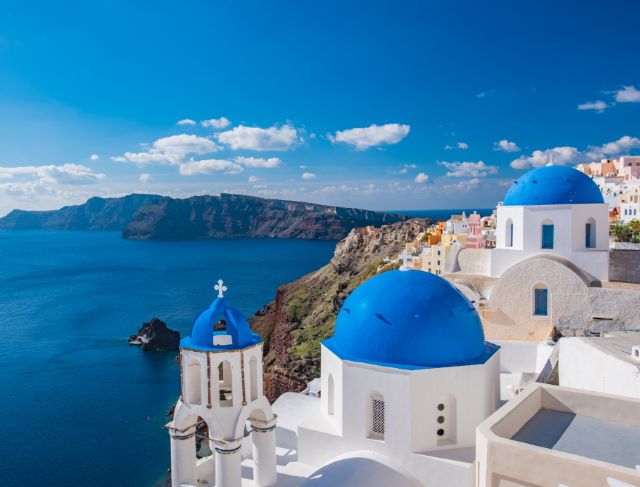

Upon arrival in Santorini, Mykonos, or Paros, tourists typically have a common expectation to see whitewashed buildings with cobalt blue roofs—bathed in glorious sunlight, with postcard-like street scenes. This provided the impression that everything is uniform throughout the islands. Travel through one of the island’s villages, and you will notice the same cobalt blue doors from every single house’s front porch, while all the chairs lining the streets are the same color as the ocean; even fishing boats seem to utilize a cobalt blue color palette. It’s almost as if there was a designer that created the entire country specifically for Instagram—long before the invention of cameras.
The irony is that the reason these buildings are generally all white has little to do with aesthetics, but rather out of necessity to reduce the amount of heat that was created by the relentless summer temperatures in the Aegean Sea. The hot summer months in the Aegean are made much worse by the sun being directly overhead at midday. When the stones on the streets of the islands are baking in the sun’s rays and the sea is reflecting those same rays—imagine living in a traditional home built with volcanic rock and other dark materials.
Those materials created an oven-like environment during summer months; therefore, the discomfort of living within them during a summer on the islands was unbearable. Whitewashing the homes provided a natural solution to this issue, as lighter colors reflect the sun’s rays, allowing the inside environment of the building to be significantly cooler than it would otherwise be with dark materials. The regional island cultures discovered that they could use whitewashed homes to create a temperature-controlled environment long before air conditioning was available.
That practical decision eventually became part of everyday life across the islands: Villagers began repainting their homes about every year, but, more typically, just before the beginning of the summer months. However, there are probably other factors besides climate that explain why entire towns came to have white exteriors.
The unexpected twist to this tale occurred in the mid-1930s as Greece was suffering through a significant public health crisis. Due to bad water conditions on many of the islands, cholera epidemics swept through several villages. The government of Greece wanted to get a quick solution to improve the sanitation of the people; thus, they forced all of the population to paint their homes white.
On the surface, painting homes white appears silly, but there is a larger purpose behind there being a ‘whitewashed’ culture throughout Greece. The type of whitewash used throughout Greece is made from limestone-based materials that have disinfectant qualities. By periodically painting buildings, you will disinfect the buildings (walls, streets and all public spaces) multiple times a year. Therefore, the ‘white village’ became a large sanitation project, camouflaged as architecture.
The cholera risk has passed, but the colour white has remained firmly entrenched as a part of island living: Tourists travelling to the Cyclades have an image of Greece being full of bright white villages against very blue seas. This image became so very clear and everlasting due to its uniqueness.
Many years later, after the military dictatorship of the 1960s, a new national paint scheme was implemented for Greece. This time the government wasn’t just concerned with sanitary reasons for having a uniform house color. They wanted to give a sense of unity to the people living in these island communities by requiring that when painting their homes they use white and blue, which are the colors of the Greek flag. This would help to symbolize that they belonged to one nation as they looked to their left, right, above, below and straight ahead; they could see the white and blue of the flag reflected in their homes, churches, windows, boats and public spaces.
The blue and white of the flag soon became synonymous with Greece. A tourist from North America and Europe would recognize this distinctive visual identity as soon as they stepped off the plane. Travel magazines at the time contained an abundance of photographs of the little blue domes and the white painted staircases up the cliffs that hug the shoreline of the Aegean Sea. The Greek islands became one of the most recognizable travel aesthetics on the planet.
What is most interesting about this evolution of look is how many non-related factors worked together simultaneously to create the aesthetic. The intense heat gave the owner the desire to have a white house because it would keep the interior cooler than other colors. Serious disease outbreaks caused large amounts of whitewashing of the interior and exterior walls of homes. Politics created the necessity to have blue and white painted on the same canvas, and finally, through the commonality of travel, that same aesthetic became solidified in the global conscious when those who traveled to these islands fell in love with the views of the landscape.
Each year, thousands of tourists visit these places to try to experience this same feeling. Sunset crowds fill narrow alleyways looking for that perfect photo. Many restaurant owners paint their chairs blue because they know this is what visitors expect. Many hotels have designed their interiors around the colours of the island. And many souvenir shops unintentionally continue this tradition by offering more and more combinations of products that are white or make use of the blue and white colour scheme of Santorini.
One reason people believe the colours of Santorini really belong to Santorini is that white reflects so much sunlight that many buildings in Santorini appear to glow during the afternoon. Also, blue is such a perfect representation of the surrounding sea and sky that the buildings look like they are part of the entire landscape. The feeling of walking around these towns is so calming that it’s hard to put into words until you’ve experienced it yourself.
Little churches appear between street corners. Cats lay on the painted stairs of houses. Clothes dry from balconies high above the water below. Fishermen repair nets against blue doors that are weathered from the sun and salt air. Every place appears to be a scene from a movie, even when they are not attempting to create that effect.
For decades and through many forms of interaction, such as heat, public health issues, laws regulating the state, nationalism and mass tourism, we are witnessing the evolution of one of the world’s most beautiful architectural styles. What originally arose as a method of survival has now become a part of the definitive identity of travel culture worldwide.
When viewing the typical images of Greece’s blue and white islands posted on the Internet, there is more than just a pleasing image to consider. There are also stories about the weather, politics, measures to prevent diseases, and the unique means by which history has created beauty.