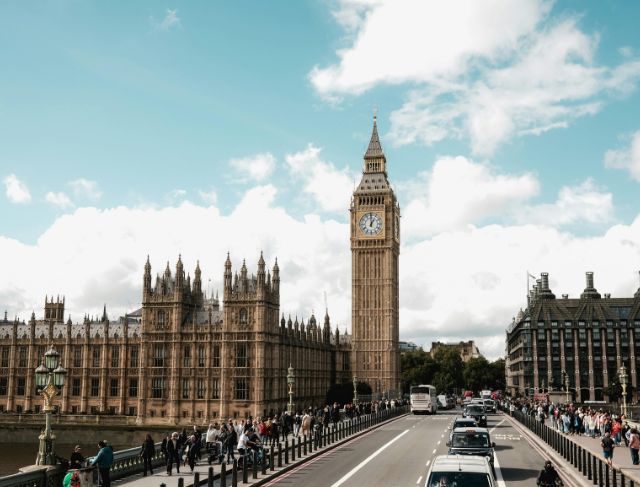

The main reason for this discontent is that Big Ben is not actually the name of the clock tower; it is the name of the bell. The tower itself is officially known as the Elizabeth Tower.
Another common mistake made by first-time tourists is to confuse Tower Bridge with London’s Bridge. Many tourists have been confused by the naming conventions in London.
Nevertheless, the clock tower remains one of the most recognized landmarks on the planet.
As if all this wasn’t enough fun, there was another tower prior to the current tower on this site. There have been many clock towers at this location throughout history. The first clock tower is believed to have been built at this location in the late 1200s, and the second was constructed during the 1300s and was one of the first chiming clocks in England. All of these previous clock towers no longer exist, and the site of Westminster has gone through significant modifications over time.
In 1834, a huge fire devastated the Palace of Westminster leaving very little left of the original building. This was a wonderful opportunity to rebuild an entirely new Palace of Westminster and the architect who won the competition to redesign the new palace was Charles Barry. Barry included the help of Augustus Pugin who had a great deal of experience with building in a Gothic Revival style and his work helped create the way that many visitors visualize the palace today.
The new palace had many architectural features including tall pointed windows, stone carvings, spires and abundant ornamentation. During this time, people were still using the sun to tell them what time it was each day so only a very ambitious man would have demanded an accuracy of one second in a clock. The final mechanism for the clock was built by Edward John Dent and was made to be used by the experts at the Royal Observatory in Greenwich who would monitor the accuracy of it for centuries to come.
The designers desired the tower to have an enormous (altitude) height, along with enough volume to dominate the London skyline. During construction, the first version of the bell developed a crack when struck multiple times by the testing hammer. The second version of the bell also developed a crack not long after installation. Instead of replacing the second version, the engineers rotated it, repositioned the hammer, and took action to prevent the crack from continuing to propagate.
Interestingly, the imperfection of the bell has become a part of the identity of the tower. The famous chime of the bells heard throughout London has a slightly different sound than all of the other bells due to this imperfection. It is one of those rare instances in which an imperfection resulted in a much more iconic structure.
During World War 1, the bells of the tower were not rung for years in order to deny direction to enemy aircraft navigating into London. During World War 2, the Palace of Westminster was bombed; however, the tower sustained little damage during these attacks (with the exception of a single bomb shattering glass within the face of one of the clock dials on the clock). As such the tower has come to be more than just architecture; it has become a symbol of enduring strength.
During the renovation of the Elizabeth Tower, also known as Big Ben, modern craftsmen stripped it of dirt, grime, pollution and aging stone. Over the past 150 years or so, industrialization has caused such heavy darkening of the original design due to black soot and dirty deterioration. As a result, the craftsmen exposed the original design of the Elizabeth Tower.
Once stripped of dirt, the craftsmen revealed the original colors of the structure. The craftsmen have replaced many pieces of stone which were damaged or removed with new hand-carved stones. Each piece of glass in the clock faces have been replaced or restored to their original condition.
In terms of building access, the renovations included modern elevators located within the historic structure. Since the tower was built in the 1800s, adding modern technology required careful planning and precision to ensure the architectural integrity of the historical building was maintained.
After the restoration, the sharpness, brightness, and “younger” appearance of the Elizabeth Tower have renewed the historical distinctiveness of the entire structure. At dusk, the gold accents of the Elizabeth Tower reflect magnificently against the London evening sky when viewed from across the River Thames.
If you are visiting London, there are many excellent locations to view the Elizabeth Tower without actually going inside the building.
Many people ride bikes along the banks of the Thames because they get amazing views since you can see everything from the riverside paths around Westminster. Visiting Westminster Bridge at night is yet another classic activity where you get to see the tower lit up and shimmering above the water.
Many tourists also ride the London Eye nearby to get panoramic views of the city, which create amazing photographs with the Elizabeth Tower standing out against the rest of the skyline surrounding it.
In addition to that, after all those historical facts, restorations, wars, and technological advances, there is still something oddly emotional about hearing those iconic chimes ring through London. To me, it is one of the things that makes London feel even more permanent as the rest of the city constantly evolves around it.