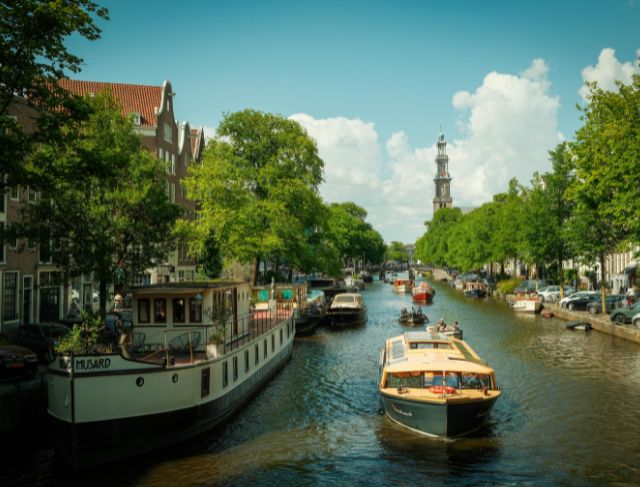

The beauty of Amsterdam’s iconic canals often catches travellers’ attention right away; it gives a feeling of tranquility, movie like atmosphere and a sense that time stands still. The narrow brick buildings lean slightly over the water, bicycles glide silently past centuries old bridge structures; every corner has an image worthy of being featured on a postcard. Most people do not know that these canal homes are an example of one of the largest economic shifts that the world has ever seen.
Curiously enough, the architectural history of these charming Dutch homes is not solely an architectural story — it’s a story about trade, about globalization, and about money.
These canal houses, at first glance, appear to be whimsical and creative pieces of architecture. They have narrow, tall shapes crammed together closely along the waterways. Many of these houses have decorative top sections called gables while others have hooks extending up near the tops of their roofs; these hooks were not for decoration; they were originally designed for lowering large cargo onto the upper floors of houses. Developers built vertically up instead of out so there were narrow, deep, tall homes available for the end-users.
Distribution of goods from around the globe by the VOC changed trade forever.
The VOC was one of the first global corporations that operated by connecting trade routes between the continents to allow for goods to be shipped across oceans. Amsterdam was one of the busiest trade centers in Europe because of its proximity to the oceans.
These canal houses were a direct reflection upon the economic growth they created.
The lower floors served as work space / trading area / storage area for merchants, while the upper floors are where their families lived. This is a strange mixture of office, warehouse and home within one skinny building.
You can still see the pulley systems that were placed near the roof, which continue to be used by the residents of Amsterdam when they move large pieces of furniture up or down their very steep and narrow staircases.
It is interesting to think that one of the most beautiful styles of architecture in all of Europe was created in part by people needing an easier way to transport large bags of pepper and boxes of tea.
The Other Hidden Social Change That Came From The Design Of Canal Houses
Another interesting part of the homes along the canals of Amsterdam is how differently they define urbanity from other cities in Europe at that time.
In many areas of Europe, affluent families lived in large estates, typically apart from commoners. The wealthy merchants of Amsterdam generally lived next to artisans, traders and other small business owners. Thus, although certain residences were more upscale, the overall plan of the city did not create a large distance between rich and poor people.
Canal houses were a big factor in creating our modern concept of the nuclear family home. In fact, prior to this time, many Europeans tended to live in large, multi-generational households or share living space with other unrelated people that were directly adjacent to where they worked.
With the introduction of the canal houses in Amsterdam, this new style of living became more private for parents and children; living in separate areas from one another is now commonplace, but represented a significant cultural transformation at that time.
The original intent of constructing canals was for business use.
Present-day tourists view the canals from a visual perspective; however, back when they were originally built, they primarily served as functional infrastructures.
The waterways served as trade routes. They allowed goods to be unloaded directly into the city center, thereby eliminating many of the problems of transportation and increasing efficiencies. Specifically, Prinsengracht (which is one of the outer canals) was a major means by which Amsterdam’s economy was able to thrive.
If the canals had not been built, the buildings that we see surrounding the canals today, would not exist in their current form.
What is interesting, is that today the entire city is perceived as a romantic and serene location, but for hundreds of years the canals were bustling with commercial activity. Workers collected products during the day and night, and had merchants negotiating contracts that perhaps established relationships throughout the world.
While Amsterdam is an incredible city today (and even was when I visited long ago), it was very busy at that time, as well.
The Hidden Darkness Behind Amsterdam’s Beautiful Structure
Canals and canal houses are gorgeous buildings. However, the history of canal houses isn’t as cheerful as the buildings themselves are.
In many cases, the money that helped create wealth in Amsterdam was acquired through colonies, exploitation, and violent trade systems of the Dutch Empire and the VOC. Goods were shipped to Amsterdam from lands where people were displaced or mistreated. European wealth came at the price of suffering in many other parts of the world.
History like this cannot be overlooked.
Canals and canal houses are examples of art, urban planning, and beauty. Yet at the same time, they also represent a period of colonization and physical, aggressive global trade. Both realities are real.
When we realize how complicated the history of canals and canal houses is, we can appreciate them and Amsterdam even more. The city is more than just a pretty spot for pictures. It visually demonstrates how global history has physically impacted the streets, the buildings, and the waterways that people enjoy today.
Why Tourists Love the Canals and Canal Houses of Amsterdam
Once you discover and learn about the dark past of Amsterdam canals and canal houses, it is difficult not to love them still.
In Amsterdam, the buildings of the city interact with the natural elements of its canals and the things that surround them. When looking at the sunset over these buildings (or vice versa), we can see reflections in the water, crooked facades, window boxes filled with flowers, and peaceful walking paths along the canals. These things create an atmosphere that is unique to this place compared to other European cities.
There is a unique blend of history, beauty, and functionality throughout all of Amsterdam; and because of that, every leaning brick structure has its own story. These stories reflect the economic history (and trade), ambition, family-oriented living, and urban transformation in this area.
Amsterdam’s Canal District is likely the most photographed area in the Netherlands due in part to the charm of the area as well as the feeling of having been there for hundreds of years.
If you happen to discover what those little hooks are used for at the top of the homes in Amsterdam, you will never look at Amsterdam in the same way again!