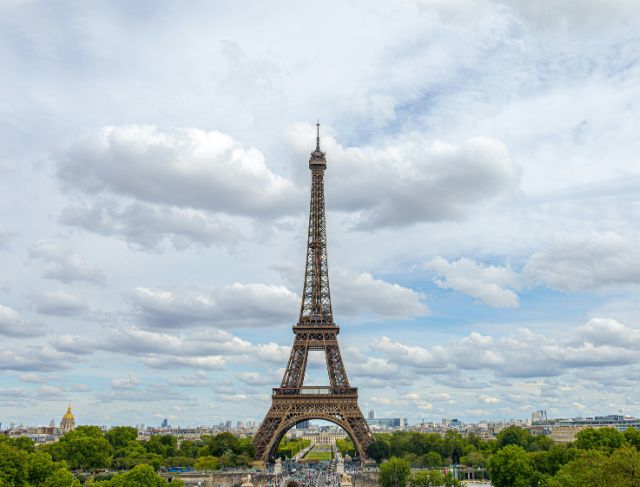

Today, the Eiffel Tower has become irreversibly intertwined with Paris. The iconic structure is featured on postcards, television and film productions, travel documentaries, souvenirs and literally every social media montage ever created about France.
The wild aspect of this story is that the Eiffel Tower was never meant to last that long.
Although it seems unlikely given that the Eiffel Tower is now one of the most famous structures on the planet, when construction of the tower began in the late 19th century, it was viewed by critics as an eyesore and an example of an industrial structure rising up over one of the best looking cities in Europe.
Comparing the Eiffel Tower to other examples of classic architectural styles you can kind of understand why people were appalled by it.
Paris is known for grand stone buildings, ornate wrought iron balconies, classical works of art and romantic boulevard. Then, out of nowhere, a massive metal building that looks like the metal frame of a factory just appeared in the middle of it all.
At the time, France was in a state of turmoil politically and emotionally. Political upheaval, generational wars, numerous revolutions, the fall of great empires and overall instability made France seek a new identity. The opportunity to host the 1889 Paris World’s Fair was a tremendous opportunity for the country to gain a new identity and be recognized as an industrial and technological giant competing against the rest of the world.
The Washington Monument was considered the tallest building in the world at the time but French engineer Gustave Eiffel had his eye on a more ambitious structure as he proposed an approximate 300-meter tall tower, almost double the height of any other structures.
Eiffel had established a reputation for metal engineering through his work with bridges and large iron structures. He also was part of a prominent monument, to the Statue of Liberty, where he designed the internal iron structure that supports Lady Liberty as she stands outside.
When the construction of the Eiffel Tower began in 1887, reactions were rampant. Writers, artists, intellectuals and people from the surrounding area complained about the project, some believing that the structure would ruin the beauty of Paris permanently, some saying that the industrial look of the tower would feel out of place in the romantic atmosphere of Paris.
The engineering ideas behind the Eiffel Tower were very progressive. Rather than building with large solid beams, Eiffel used thousands of smaller pieces of iron all connected to one another in a crisscross pattern. This allowed the wind to blow through the tower instead of hitting the tower straight on.
As a huge, solid structure, the Eiffel Tower could have had problems with wind resistance because of its size; however, with its open lattice construction, the Eiffel Tower was able to distribute wind pressure efficiently while also reducing weight significantly. Although it appeared light and delicate from a distance, it had incredible structural strength.
The Eiffel Tower’s construction could also be considered a fascinating puzzle due to how it was put together. Many component parts were constructed at factories located away from Paris and shipped into Paris before workers assembled the entire structure on-site by using millions of rivets to connect the pieces together.
Because of how the legs curve in towards the top of the tower, conventional elevators could not function correctly in this situation. Engineers were required to invent a completely new type of lift system for this project. These new systems were influenced by mountain trains and cable car systems.
The Eiffel Tower went from being the subject of ridicule during construction to being one of tourists’ most desired attractions in Paris. Tourists came from all over the world to take in views of Paris that they had never before experienced in this manner. Paris seen from the top of the Eiffel Tower was something futuristic and unfathomable during the late 1800s.
Initially, the Eiffel Tower was intended to last only 20 years before it was scheduled to be demolished due to its construction permit expiring in 1909. The original city of Paris very nearly lost the Eiffel Tower entirely.
Gustave Eiffel thought the structure could do more than bring people to Paris; he used the tower to test things related to meteorology and wind resistance as well as to experiment with radio waves. Eventually the military decided there were many ways to use the tower, and they realized they wanted to build a radio tower out of it.
The French government thought about how much the tower could help them with their military communication systems and quickly changed plans to demolish it. Instead, they intended to keep it as part of their ever-expanding network of telecommunications in France.
Today when people visit the Eiffel Tower, it is a romantic place to be viewed especially when lit up at night reflecting off the sky in Paris. However, it is not just pretty. It is a great example of engineering and continues to provide functionality within France.
When standing under the Eiffel Tower or standing next to it, looking up through all those cross sectioned steel beams gives one the ability to see why it completely captures the imagination of millions of people who visit every year. It feels simultaneously light and massive, like a piece of industrial machinery turned into an amazing artwork.