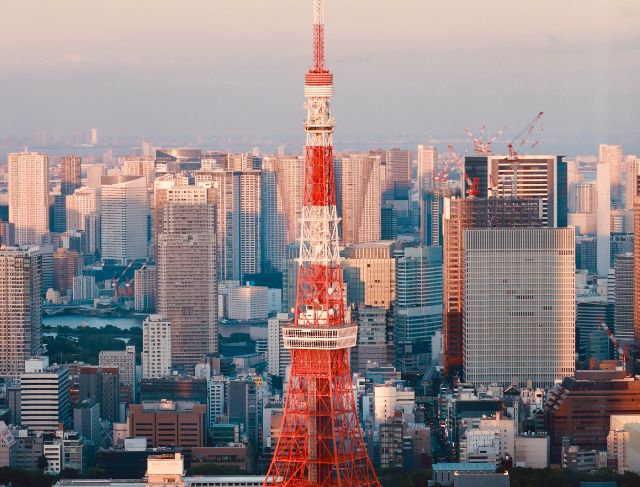

You could very well come to Tokyo without knowing absolutely anything about the city of Tokyo and still have an amazing time—however having just a few points of reference will dramatically change how you interact with the city. This is the paradoxical magic of Tokyo; it can feel so alive and on top of the world until in an instant it doesn’t.
You are standing in the middle of an impossibly large and well-lit intersection (the one where thousands of people cross over one another at the same time), surrounded by large screens with flashing lights and sounds of music coming out of stores all around you, where everything is moving at least twice as fast as it would if you really were watching it. Welcome to Shibuya—Tokyo’s electric heart. While there is certainly an element of chaos to Shibuya, it is also extremely well-ordered and has a distinct sense of organization once you begin to find your way around the rest of Tokyo.
A beautiful and very large park that is full of trees, with many tranquil walks and paths. You will hear the sounds of feet walking on paths, and not the sounds of automobiles as you would if you were walking on city streets. This is Yoyogi Park—it is adjacent to some of Tokyo’s most important shrines; even though they are so near one another, you feel as if you have entered an entirely different world. This is Tokyo’s essence—its extremes coexisting in close proximity.
Tokyo is home to the Imperial Palace: a large park bordered by a moat. It sits in the middle of many tall buildings; this marks the center of Tokyo’s political and geographic locations. Tokyo Station is nearby, and this space is full of people, as the train station constantly has trains coming and going. Tokyo Station is not simply a transportation center; it is also a small urban area.
Ginza is where Tokyo showcases its luxurious qualities – designer boutiques, modern architecture, and everything else expensive. However, below ground in this area are food halls with delicious and affordable meal options. In contrast, Tsukiji presents a different approach. This area is much noisier and messier than Ginza and includes many vendors who serve food in street markets. It is also not unusual to walk from one area that contains exceptional boutiques and find yourself in a crowded alley next to someone selling fish.
During the daytime, Roppongi is a peaceful location with art galleries and museums. However, at night, it becomes one of Tokyo’s largest nightlife areas. After dark, the area feels very different than it does during the daytime.
Shinjuku is one place in Tokyo that can be defined as having multiple identities. It has everything you would want in one neighborhood, including skyscrapers, tiny alley bars, neon lights, big department stores, and one of the busiest train stations on the planet all located within a 5-minute walking distance. When you walk around Shinjuku you get the feeling that you could walk through 3 completely different cities. The energy is intense and can be a little overwhelming at times, but it is also very exciting.
Further north is Ueno Park where you can relax, visit museums and temples, or even visit the zoo. If you find yourself overwhelmed by the speed of Tokyo, Ueno Park is the place to go for a re-adjustment. The park is quiet, peaceful, with lots of space, and has a lot of culture but not much noise.
You can’t understand Tokyo all at once, so you have to stop worrying about understanding everything at once. Tokyo will not belong to you if you wish to understand it so why would you? It is not something to be conquered; rather, it is something to learn.
In the first ten days, it is just a jumble of places and train lines. Then, suddenly, you start recognizing the places, you are familiar with those routes and your mental map begin to fit together.
You may want to consider this as the way of approaching Tokyo. Do not treat it as something you need to memorize, but rather something you slowly build a picture of—one neighborhood, one train ride, one random walk.