
Leaving your home in Washington, DC and heading to one of the area’s main airports might be one of the easiest things you’ve ever done in that metropolitan region. There is very little stress involved; there are no complicated routes that you need to understand; and there is no guesswork involved — just tap in (like a tap), follow a few colored lines, and you’re at an airport to see planes take off.
In fact, if I had to say there is anything ‘magical’ about the DC Metro, it would be this. There are very few systems in the world as easy and fun to use as this one. Most people (nearly 500,000 people/day) use the Metro to get from their place to work and from their place to home on a daily basis. This fact is indicative of how active the Metro system has become throughout the entire city, with trains constantly running under and over the city (throughout Maryland and Virginia).
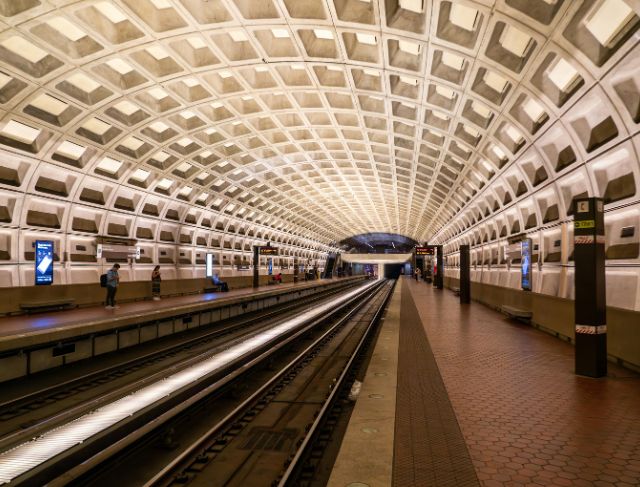
Additionally, the stations look and feel…, different. Most have large open spaces (high ceilings); they all have large concrete pillars that support the ceiling; they all have ‘softer” lighting than the ambient light that you would find in most traditional transit systems, making them feel futuristic in some instances but also retro at the same time. All of the above characteristics were designed with a clean, minimal aesthetic, but there was clearly an intention behind the design to make it work, not just function. Furthermore, the signage associated with the Metro is significantly different from that seen in most older transit systems (e.g., New York or Boston); therefore, navigating the system is not nearly as chaotic as it is in other cities
The Washington, DC Metro system is relatively new compared to the New York City subway systems and other older subway systems. The Washington Metro System only opened for service in 1976 whereas the NYC subway opened for service in 1904. The difference in age between them is almost like comparing something thousands of years old with something that opened recently. You can certainly feel how new the system is as it has a much smoother ride, the stations are cleaner, and everything is just a little bit more… orderly.
Imagine you’re at a Metro station with your card in hand and you are trying to figure out how to get to where you want to go (for example, the National Mall or the airport). There you are looking at a map that has multiple colored lines (red, blue, yellow, orange, green, silver) and looks to be completely overwhelming initially.
However, when you break down the map, the color lines represent the train lines, some of which share the same track, some of which connect back together and all of the dots represent a stop. Some of the dots (transfers) are larger than others, and if you look closer at the larger dots, you will find that they serve as transfer stations for those who want to transfer from one line to another. Once you have this information, you will be able to read the map without any difficulty.
One of the busiest lines in the Metro system, the red line, curves throughout the city in a large “U,” connecting you to some of the city’s best spots such as Metro Center and Union Station. If you will be travelling to Washington from out of town via bus or train, youwill likely begin at Union Station. Once you arrive at Union Station, you will be walking distance to some of the city’s most famous landmarks.
If you are arriving through Reagan National Airport (we locals know it better as DCA), you are already connected to the city. You can get from there to downtown in a matter of minutes by hopping on the yellow line! If you’re arriving through Dulles Airport, you’ll take the silver line, which travels directly to the center of DC without the need for a taxi or rideshare.
If you’re planning on visiting the many museums, monuments, or just want to experience all that DC has to offer, you can’t miss the Smithsonian Station. It is impossible to get lost when the station has a name like that.
You will need a SmartTrip to ride Metro; that’s similar to a prepaid debit card for public transportation. You can buy a physical card at the metro station, or you can pay by phone if your phone has contactless payment capability. You can load money onto this card, tap-based when entering and tapping again when leaving. The fare will be determined automatically.
Fare is determined based on the distance you are traveling. Shorter trips will be lower in fare than longer trips, but there are some flat rates for late night and weekend travel.
Most people use their phones’ apps and not just the subway maps. Google Maps, Citymapper, etc; and you will enter where you are and where you want to go and get turn-by-turn directions. The exact train numbers, direction, and transfer points are provided with each option. Also, the apps track real-time updates so if there is a delay you will know about it.
With that being said, don’t solely trust your phone, always check the screens posted in the subway stations and listen to any announcements. Technology can assist you, but in some way it cannot replace good judgment!
At Cleveland Park station, you want to go to the airport. The app says you should take the red line, switch to the yellow line at Gallery Place, and continue riding until you reach DCA. That’s it! As long as you follow the signs, check which direction you’re supposed to go (usually indicated by the last station on the line), board the train, and ride!
Once on board, it gets even easier. There are digital screens that show the upcoming station. You hear announcements telling you what station you’re at and there are maps inside each car. You have to really work at getting lost!
And then suddenly, you’re at the airport! You’re there with no traffic and no stress!
Before I finish, there are a couple of unspoken rules you need to know. They are simple, but many people take them seriously.
When on the escalators, stand to the right side. Always. The left side is for those who want to walk. If you block the left side of the escalator, you will definitely feel people’s silent judgment!
Be sure your card is handy when you arrive at the door to enter the Metro system so that you are not the one looking for the card at the last second as people stand behind you waiting for you to find it.
The Metro system is that it can be intimidating the first time you look at it, but soon you will see how easy it is to use the Metro to travel around the city.
If you have plans to visit the National Gallery of Art, National Mall, or to travel out of DC by flying to your next destination, you will find that the DC Metro performs its function without fanfare and does this job well.