
Barcelona feels like two cities in one. One is a chaotic, ancient maze while the other is a clean, geometric and super-organised place. The contrast makes it an amazing city to visit.
The personality of the city can be summed up by one word—tension. Old vs. new; planned vs. organic; history vs. reinvention—that’s Barcelona.
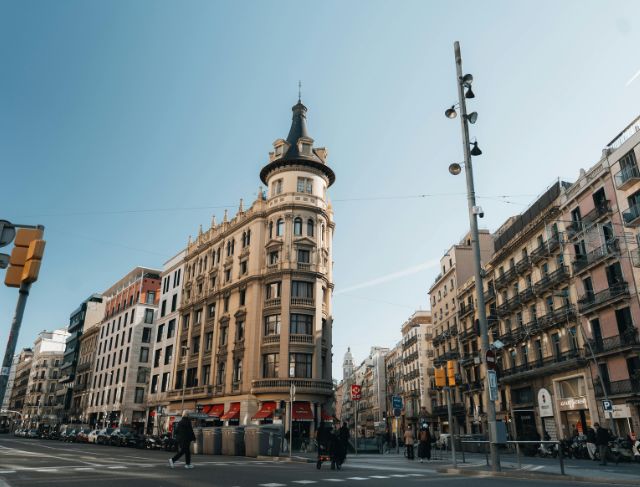
As you walk through the Eixample district, you suddenly notice everything appears… orderly. The street grid is perfectly rectangular; the corners of blocks are cut into an octagonal shape; this gives intersections a great sense of openness and space. The designer of these features, Ildefons Cerdà, was an enthusiastic planner who envisioned a healthy city, with sunlight in every corner, air flowing through it freely, and common parks in every block. You would think this kind of planning is contemporary, but it dates back to the 1800s.
What you see today doesn’t necessarily reflect what Cerdà had in mind—over the years many buildings have been added to the skyline; narrow streets have been created; and the green spaces that were once in the interior of the blocks are now a series of parking lots—but the grid remains one of the preeminent urban designs in the world.
Barcino, which was a Roman settlement that preceded modern day Barcelona, had a fairly rigid Roman structure and was enclosed by fortification walls. Once hundreds of years passed, that location eventually became the current Gothic Quarter and is now an entirely differing style with its narrow streets and alleyways, uneven surfaces and pockets/courtyards making it feel as if you are walking through a maze with no design plan.
Between the two areas is La Rambla, which actually did not begin as a street but initially was a stream running outside of the city wall. Eventually over time it had dried, became a public gathering area, and finally transitioned into the most trafficked boulevard in Barcelona. La Rambla is currently filled with people, entertainers, vendors/markets, and every form of energy you can imagine. If you walk down to the waterfront from Plaça de Catalunya, you will learn why La Rambla represents a must-have Barcelona experience.
Barcelona was created through means of pressure not only by city growth occurring naturally. This resulted in 200 years of confinement, due to being surrounded by walls, and the subsequent growing of the population over that time period. When industrialization began to hit Barcelona, and they experience mass overcrowding due to issues with hygiene, disease and the lack of physical space, the walls opened up providing an opportunity for extensive land redevelopment to occur with the completion of the Eixample plan. This also represents a significant new beginning for the city.
The location of Barcelona has also played a critical role in defining its character. Located between two rivers, with mountain ranges inland, and the Mediterranean Sea, the city is home to beautiful beaches on one side; while on the other, there are majestic hills like Montjuïc which is an historical landmark dating back hundreds of years as a lookout point prior to becoming a military installation, then eventually becoming home to cultural events and tourist attractions.
Barceloneta is a neighborhood that formerly did not exist. The sand built up around the port to replace former housing for displaced persons from military activities created this community. Today, it has emerged as one of Barcelona’s premier coastal neighborhoods.
Continuing into the 20th century, Barcelona continued to redefine itself by leveraging large international events. Both the 1888 and 1929 Expo produced large-scale developments in parks, monuments, and public spaces; but none were as impactful as the 1992 Olympic Games.
The coastal industrial neighborhoods surrounding Barcelona were transformed into beaches; the infrastructure was overhauled; numerous neighborhoods were redesigned; and Barcelona used these staging of the Olympics as an opportunity to reposition itself to a world-class city and it has remained on that world stage since then.
Barcelona isn’t only a city in Spain but rather also represents a much larger region of Catalonia with its own sense of identity, culture, and language. You can undoubtedly notice this sense of strong local identity around the entire city, from its architecture down to its food and how people go about their daily lives; even if you don’t get involved in the politics surrounding the region, you can definitely feel the city’s distinctive local character.
When it comes to architecture, it is impossible for anyone visiting Barcelona to miss seeing the work of architect Antoni Gaudi. His many works of art are sprinkled throughout various parts of Barcelona, including his surrealistic Park Guell and the still-unfinished Sagrada Familia, which are both types of buildings and experiential artworks. Each of these types of structures are meant to be enjoyed by people—not just individuals—but groups that come together via several means in order to experience the art being done through the creation of buildings in the city; therefore, each of these types of structures has helped add an additional layer to an already layered personality of the city.
Despite all of these historical, planned, shaped, and built aspects of Barcelona, it still has a very human feeling about it because of all of the street markets, late-night walks, local people mingling with visitors, and even the combination of old stone and modern glass construction.