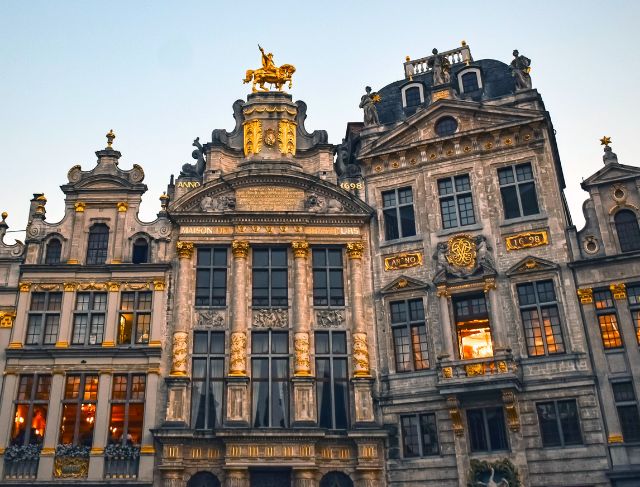

The majority of the cities in the world run on relatively straightforward lines. The residents speak in their home tongue, the official institutions provide services using their principal language and almost all aspects of everyday life happen in the same way. That is until you come to Brussels.
In the Belgian capital, you can order your coffee in English, read official government documents in French, hear your train announced in Dutch and have a chance to meet people from many different countries before a lunchtime even comes around. What makes Brussels one of the most interesting cities in Europe is not its buildings but rather how language has an effect on everyday life.
Brussels is Unique from Other European Cities
Many countries in Europe have more than one official language; therefore, having multiple languages does not differentiate Belgium from any other country. However, one thing that makes Brussels different than most countries is that in Brussels, the use of a foreign language is regularly much more common in day-to-day activities than one of the country’s official languages.
In Brussels, both French and Dutch are both the languages of governance and officialdom. However, the English language has become the practical link to connecting thousands upon thousands of international residents, diplomats, business people and students.
Thus, Brussels provides visitors with an experience unlike that to be had in most other countries in Europe.
The Creation of Capital Built Upon the Complexity of Language.
Concerning how to comprehend present day Brussels, one must also look at Belgium.
Belgium has different language areas with French being spoken mainly in the southern part of Belgium, Dutch being used mostly in the northern part, and a small population of German speakers along the eastern border. Brussels has both French and Dutch as their official languages; over half of the citizens are bilingual in both languages.
This did not happen over a period of time.
For hundreds of years this land was fought over by different European countries until Belgium became its own independent country in the 19th century and had a language issue right from the beginning.
The Long Road To Language Equality
In the beginning years after Belgium was established as a country and through out most of its history, the French language was the dominant language in government, legal systems, and in government services.
However, many Dutch speakers did not feel that they had a voice in society and they as a group made up 60% of the country. However, the Dutch speaking people of Belgium have fought for legal rights through political reforms.
This created a territorial language system in which each region of Belgium would operate through their territorial language. This created clear administrative, educational and legal boundaries.
Today, the city has a distinct structure for its language, which is evident even in the everyday lifestyle of people living in Brussels.
Every morning in Brussels, you get out of your house and start walking down a street with signs in both French and Dutch. You go into a café and hear conversations at the tables around you in a variety of different languages.
The barista greets one customer in French, one in Dutch, and then immediately jumps to English to speak to a visitor or someone who works at an international company downtown.
This ability to switch from language to language has become part of the character of the city.
If you’re new to Brussels, it can be overwhelming at first. For residents, it’s just another day.
Brussels is the capital of the European Union and many of the largest companies in the world are located there.
Brussels has so many European institutions because they have built large offices there over the last few decades. By hiring employees all over the continent and from other countries, these institutions have brought millions of expatriates to Brussels.
Most of these new employees do not share either French or Dutch as their native tongue; therefore, English became the common language.
English is widely used in the workplace, international businesses, networking events, social activities, and other activities throughout the city.
Brussels is a City Created with the Needs of Foreigners in Mind
You walk through Brussels and feel that it is an international city.
You will see that there are entire sections of English-language books in bookstores. You will find that restaurants usually have menus printed in many different languages, and there are schools that serve children from all over the world.
In some neighbourhoods, you will hear just as many people speaking English as French.
Many expatriates are able to enjoy both the local culture and the fact that they can live in an internationally accessible place.
Language is a Major Factor in Everything in Brussels
Language has an impact on much more than just conversation in Brussels.
It also impacts how education, government services, legal matters, public transportation, and even how media is consumed.
Families often find that choosing between a French-language or Dutch-language system of education for their children requires them to make a decision about which language to use in their day-to-day lives. Many newspapers are published in either French or Dutch, and often, the same is true for administrative forms.
While this may seem confusing to some, it actually reflects Belgium’s commitment to supporting multiple cultural identities within a single nation.
Brussels Is More Than Just Government
Whether through bureaucracy or political institutions, Brussels may have a reputation for them both; however, it also has an active cultural life.
Historic buildings, world famous chocolate, numerous cafés, art galleries, and the culinary talents of the restaurant community all contribute to the appeal of Brussels.
Yet, many travellers leave Brussels with experiences that go beyond site seeing.
For example, they return with memories of hearing different conversations in multiple languages simultaneously. They recall the difficulty in finding their way through multilingual and multicultural train stations. They also recollect how easily people interacted through various forms of communication despite their diverse backgrounds.
These experiences provide a better definition of Brussels.
The City of Modern Europe
Brussels is more than just the capital of Belgium; it is a city that exemplifies the ability of its different cultures, languages, and communities to coexist within a single urban environment.
Although Brussels is not the easiest or most organized city, that is what makes Brussels such a compelling destination.
Brussels is unique among the world’s cities; whereas many cultures and nations primarily operate with a single national identity and/or language, Brussels operates as a functional community that embraces diversity through continual change and adaptation.
For this reason, many have declared Brussels one of the most unique cities in Europe.