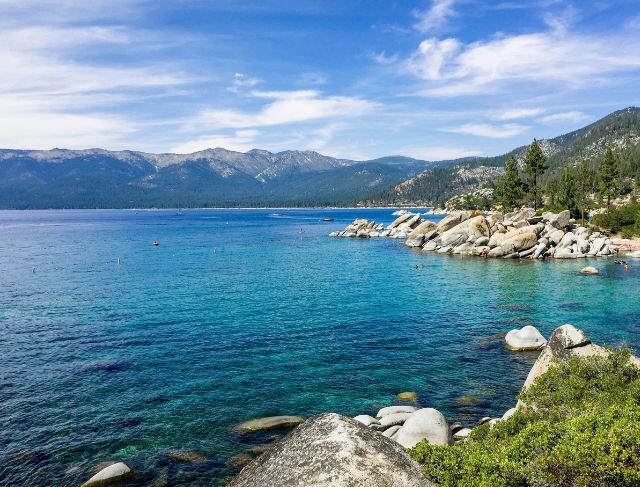

When people come to Lake Tahoe, they see the stunning mountains. They also don’t expect to see clearly to the bottom of a lake, like many travelers have when looking out over a beautiful lake.
Jumping into the water will probably be your first instinct.
Your second thought will likely happen just after you jump in. You will quickly realize that the water is cold.
The contrast of being able to see the warm tropical-looking waters of Lake Tahoe, against the cool snow capped mountain peaks of the Sierra Nevada makes Lake Tahoe an amazing place to visit.
Besides the scenic beauty, Lake Tahoe is also considered by many to be one of the oldest and deepest lakes on the planet.
Lake Tahoe is about 22 miles long, from north to south, and approximately 12 miles wide at certain portions. Lake Tahoe is about 1,600 feet deep at its deepest point, and is therefore the second deepest lake in the United States and one of the deepest on the planet.
Distinguishing how deep something is can be rather difficult to visualize. If we took the Empire State Building and put it at the bottom of Lake Tahoe, you would still have a long way to go to get to the top of the building under the surface of the lake.
The depth of Lake Tahoe has been created by the same intense geological activity that continues to shape Lake Tahoe today.
The reason Lake Tahoe has such an extraordinary amount of depth is due to the fact that Lake Tahoe is located on a fault line that separates California and Nevada. Slowly, over the past few hundred thousand years, as tectonic activity pulled the region apart, the Lake Tahoe basin was gradually elongated and the Sierra Nevada mountains grew progressively taller.
That is why Lake Tahoe is a large mountain lake surrounded by very abnormal mountainous terrain.
While the depth of Lake Tahoe is more than enough to catch anybody’s attention, one of the main attractions to visiting Lake Tahoe is its exceptional clarity.
Also known as the “Lake in the Sky”, the primary source of water for Lake Tahoe comes from melting snow and ice from the nearby mountains. Many streams and creeks feed directly into Lake Tahoe providing exceptionally pure water.
Many people have said that when conditions are perfect, there are times when you can see clearly through the water to the bottom of the lake, causing it to appear more glass-like than to look like a lake located in a mountain.
Unfortunately, for Lake Tahoe to reach those conditions again in terms of clarity, there is an ongoing fight for Lake Tahoe to maintain its water’s clarity.
Urban development has prompted increased water runoff from the land; meanwhile, invasive aquatic species have changed the ecosystem. The scientific community along with conservation organizations continue to work to preserve one of Lake Tahoe’s most treasured attributes, while scientists race to understand the extent of how these developments will affect the water quality in the future.
The Washoe have lived around Lake Tahoe long before tourism began.
The Washoe had lived in the Lake Tahoe Basin for thousands of years prior to the influx of tourists in the 1800s. Each summer, the Washoe would fish and gather food; however, with the onset of winter, they would be required to prepare to weather the hardships of winter within the Sierra Nevada Mountain range. Lake Tahoe provided their people with a physical location at which they could establish and develop their culture and spirituality.
One location that has particular significance for the Washoe is Cave Rock; a place that continues to be an area of great spiritual and cultural significance to the Washoe people.
The California Gold Rush changed everything.
When the miners and settlers flooded into the region in search of opportunity, the Washoe gradually lost virtually all of their native land. By the mid-1860s, most of the Lake Tahoe Region had been claimed and occupied by those who had moved into the area.
The environmental impact of the Gold Rush was equally as significant.
The demand for timber skyrocketed as mining operations grew larger. Large areas of forest surrounding Lake Tahoe were cleared to provide for mining infrastructure. As a result, less than 10% of the original trees surrounding Lake Tahoe remain.
It took centuries for the forests that visitors enjoy today to fully recover due to natural regrowth and conservation.
Originally, Tahoe was a destination primarily for wealthy individuals for several years.
Traveling to the lake was quite difficult before modern-day transportation options were available due to the rugged Sierra Nevada mountains, which provided geographical barriers impeding access.
With little access to the area due to its remoteness, elite retreats, luxury resorts and private estates flourished along the shoreline.
Visitors who traveled to Tahoe were looking for fresh mountain air, an opportunity to relax, and potential medicinal benefits. At that time, various health-related conditions such as tuberculosis were believed to be addressed by spending time in the mountains.
Bellevue villas appeared on the lakeshores even then and can still be seen today.
As automobiles became a regular part of everyday life and as existing roads improved, there was an entirely different reason to travel to Lake Tahoe.
Families had found it much easier to get to the lake than ever before, and tourism would continue to expand, transforming Lake Tahoe into one of the premier outdoor recreation destinations in America.
Summer at Lake Tahoe included recreational activity such as boating, hiking, swimming and camping.
Winter recreations at Lake Tahoe would include skiing and snowboarding of the highest caliber.
Today, visitors have the opportunity to experience Lake Tahoe from season to season; however, each season has different qualities that provide different types of recreation.
Even though Lake Tahoe has been developed into a popular vacation destination over the years, it still has areas that feel untouched.
On a tranquil morning, the sun rises over the lake, its rays gently illuminating the soft falling snow in the pine forests; the still waters of the bay reflect the boats that glide over it, creating a moment to cherish for years to come.
Lake Tahoe inspires people to return time and time again.
Many people visit for the views.
Others come to experience the outdoors.
Some simply want to relax by the sparkling lake, breathe in deeply the fresh mountain air and enjoy one of the most spectacular natural locations in the U.S.
Lake Tahoe is not just another stunning lake. It is an incredible combination of geology, geography, history, art, culture, and nature coming together to form an outstanding landscape.